
Green flags in a guy are patterns you can watch repeat, not gestures you can be shown once. They are harder to write about than red ones, because good behaviour is quiet. Nobody screenshots a man taking a no gracefully. But without a clear picture of what good looks like, pattern-watching slides into paranoia — every quiet evening becomes a clue, every flaw a warning. This page is the other half of the red flags in a guy page: same standard, opposite direction.
The same honest note applies here. Green flags don’t have a gender. This page exists because this is how people search, and the examples fit the search — the general version lives at green flags in a relationship. Nothing here means “a good man does X”; it means: if you’re dating a guy and wondering what’s actually worth trusting, look here rather than at the size of the gestures.
What counts as a green flag in a guy?
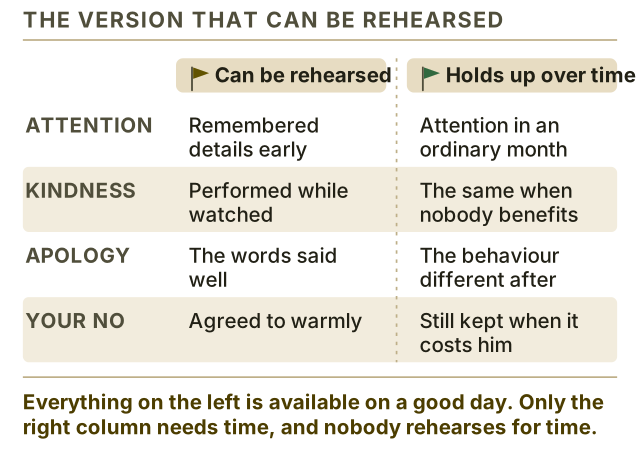
A green flag is a repeating behaviour that holds up under friction — not a gesture, not a vibe, not a good week. Flowers are lovely and prove nothing. “He has apologised first, more than once, without being cornered” is evidence, because it repeats and because it costs him something each time.
That definition does the same work the red-flag one does, in reverse. A red flag needs repetition and a direction before it means anything; so does a green one. One thoughtful act is a day. The same consideration showing up across different situations — when he’s tired, when he’s losing, when nobody useful is watching — is a pattern with a direction.
And a green flag is not a verdict either. A genuinely kind man can still be wrong for you: mismatched lives, mismatched wants. Green flags tell you the relationship is safe to explore, not that it’s guaranteed to work. A flag is a behaviour you watched repeat over time, not a guarantee about a person — and this page cannot see your relationship, only describe the pattern.
How does he handle your no?
This is the biggest one, so it goes first. Watch what happens after you decline something, such as an invitation, a pace, a topic, or a favour. The green version is almost boring: the no lands, he adjusts, the evening continues. No sulk to manage, no renegotiation an hour later, no invoice arriving as guilt.
The pattern matters more than the politeness. Plenty of men accept a no gracefully in the moment and reopen it later as pressure. The flag is a no that stays accepted — the first time, without a cost you pay afterwards. If saying no to him feels roughly as easy as saying yes, that is a structural fact about the relationship, and it predicts more than any romantic gesture does. Saying the small version out loud is its own difficulty, and there is a whole literature on it: Nedra Glover Tawwab’s Set Boundaries, Find Peace is a therapist’s book built almost entirely around that sentence.
The mirror version of this — a no that gets punished with sulking or pressure — is the single most reliable early red flag, which is exactly why its opposite leads this page.
How does he lose an argument?
Everyone is gracious while winning. The information is in how he loses. The green version: he can say “you’re right” without a rematch, “I handled that badly” without you extracting it, and the argument ends when it ends — it doesn’t go underground and resurface as coldness two days later.
Notice what this is not. It is not a man who never argues, always yields, or has no opinions — constant agreement is its own quiet warning, because it usually means someone is managing you or disappearing themselves. The flag is disagreement that stays about the topic: two people arguing about the dishes, not two people using the dishes to argue about who matters. The toxic vs healthy page puts these same scenes side by side if you want the full comparison.
How does he talk about his exes?
Listen for whether the people in his history are people. “We wanted different things”, “I was a bad partner at twenty-five”, “she’s doing well, I think” — these are green, not because they’re generous, but because they show he can hold two sides of a story he lost.
A villain-only history is one in which every ex was the problem and he was never a participant; the green flag is specifically its absence. A man who can name his own share of a failure will likely name it in your relationship too, which is the trait you’ll actually need at some point. He doesn’t have to be friends with his exes, speak warmly, or want to discuss them at length — privacy about the past is normal. The flag is fairness, not fondness.
How does he treat people who can’t help him?
Waiters, drivers, junior colleagues, his mother’s neighbour. This is the classic test for a reason: with you, early on, he is performing; with people who can’t push back and can’t advance anything, he is not. Consistent, unremarkable decency toward them is one of the most honest signals early dating offers.
The green version has a specific texture: it’s boring. He doesn’t perform kindness to the waiter for your benefit — that’s a gesture again — he’s simply the same person in both directions. The charm has no off switch tied to usefulness. Watch it across a bad evening, a wrong order, a long queue. Patience that survives inconvenience is a pattern; patience that lasts exactly as long as the date is going well is a costume.
| Looks green | Is green when it repeats under friction |
|---|---|
| A grand romantic gesture | Small promises kept without reminders, for months |
| “You’re right” said to end a fight | “You’re right” followed by changed behaviour |
| Polite to the waiter on date two | Same patience during a bad evening and a wrong order |
| Agrees with everything you want | Disagrees openly, and the no stays safe on both sides |
| Intense attention and fast plans | Relief, not injury, when you ask to slow down |
Is it safe to be unimpressive around him?
This one is less visible and worth naming, because almost nobody lists it. Imagine failing at something small in front of him: a bad day, a wrong turn, a story that flops, crying at an inconvenient time. The green version: nothing happens. No teasing that stings, no filing it away, no subtle shift in how he treats you.
Safety-to-be-unimpressive is the load-bearing green flag for long relationships, because long relationships are mostly made of unimpressive days. Its early form is small: how he reacts when you cancel, when you’re tired, when you’re not fun. If you notice you’re editing yourself down to stay likeable, that’s data too — about the dynamic, not necessarily about him — and it belongs in your notes either way. What is being tested is whether reaching for someone gets an answer, and Sue Johnson’s Hold Me Tight is a book-length account of that, written out of emotionally focused therapy and about couples in general rather than yours.
Can green flags be faked?
Gestures can, easily; patterns mostly can’t. Anyone can run generosity, attentiveness, and charm for a few months; intense beginnings are pleasant and prove nothing by themselves. Intensity used as a tool for speeding up commitment is a pattern of its own, described elsewhere on this site. A manufactured green flag has a shelf life, and it usually expires the first time a no is genuinely inconvenient.
So the verification isn’t cleverness, it’s time plus ordinary stress — such as a cancelled plan, an illness, a boring month, or a disagreement about money. You are not looking for a man who passes every test — that man doesn’t exist — you’re looking for whether the good behaviour was a performance with an audience, or just how he is. Performances need an audience. Patterns don’t.
What does a pile of green flags actually mean?
It means the relationship is safe enough to keep exploring at your own pace — that’s all, and that’s a lot. Green flags aren’t points to accumulate toward a decision, and a man isn’t a scorecard. Someone can carry every flag on this page and still not be your person.
What the green picture is for is calibration. If you’ve read the red-flag pages first, you now have both halves: what a bad pattern looks like early, and what an ordinary good one looks like. Held together, they protect you from the two classic mistakes — explaining away a real pattern, and pathologising a normal person. The rest of the healthy baseline lives in the healthy kind hub, and it ends the same way this page does: with your eyes open and the pace yours.