Most lists of green flags in a relationship read like a barista’s job description: brings you coffee, remembers your order, texts good morning. Pleasant, and almost useless. Nice gestures are the easiest thing in the world to produce for a while, which is exactly why they predict so little. Green flags in a relationship are the repeated behaviours that hold up when being decent costs something. They live somewhere less photogenic than the lists: how a person loses an argument, what they do with your no, and whether it is safe to be tired, wrong, or unimpressive next to them.
This page is the mirror of the red flags checklist, and it exists for a practical reason, not a decorative one. If you only ever study what bad looks like, every ambiguous moment starts reading as a warning. Pattern-matching without a picture of healthy drifts into paranoia. Green flags are the calibration — the base rate of good that tells you whether what you are seeing is a bad day or a bad direction.
What is a green flag in a relationship?
A green flag is a repeated behaviour that predicts being treated well when it is inconvenient. The meaning matters in every word. Repeated: one generous act is information, not a flag. Behaviour: what a person does, not what they say about themselves (“I’m a really good communicator” is a claim; asking a follow-up question when you are upset is a behaviour). And inconvenient: anyone can be lovely when the evening is going their way.
That definition quietly disqualifies most of what the internet files under green flags. Flowers, planned dates, fast replies — these are compatible with wonderful relationships and with terrible ones, because they cost little and signal effort, not character. The pattern underneath is what you are actually trying to read: does this person stay decent when decency has a price?
One symmetry with the rest of this site holds here too. A green flag is not a verdict any more than a red one is. It does not certify a person as safe, and this page does not know your partner. It describes patterns worth trusting more, the same way the red pages describe patterns worth trusting less.
Why do green flags matter more than a list of red ones?
Because without them you have no baseline, and without a baseline every relationship eventually looks suspicious. Consider someone who has only studied warning signs: they see a partner who wants a night alone and read withdrawal, see a strong opinion and read control, see an off day and read the beginning of a cycle. The list designed to protect them starts prosecuting normal life.
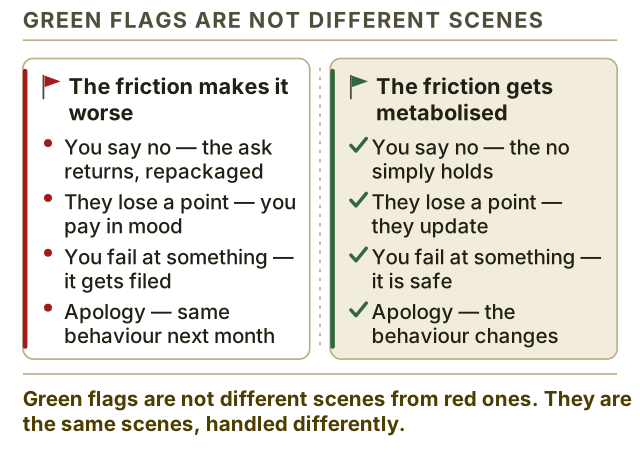
Green flags fix the reference point. If you know what a healthy version of an argument, a jealous twinge, or a hard week looks like, you can place what you are living against it, instead of against a worst-case catalogue. That comparison — same scene, two versions — is the entire method, and it gets a full treatment in toxic vs healthy, side by side.
There is a second reason, less discussed. People who grew up around bad patterns often cannot recognise good ones; calm reads as boring, kindness reads as weakness or as a trick. For them, a concrete picture of healthy is not motivational content. It is missing equipment. If a page-length version is not enough, Sue Johnson’s Hold Me Tight is a book-length description of the same thing, written out of emotionally focused therapy; it describes couples in general, not yours.
What are actual examples of green flags?
The honest examples are scenes under friction, so here they are as scenes. Every one counts only as a repeat.
They can lose an argument. Not perform surrender to end the conversation — actually update. “You’re right, I didn’t think about it that way,” followed by behaviour that reflects it. Watch what losing costs you: with some people, winning a disagreement means paying for it in mood for two days. A partner who can be wrong without making you responsible for their feelings about it has the single most load-bearing skill in a long relationship.
Your no closes the topic. You decline something — an event, an expense, a request in bed — and the no just… holds. No sulk to manage, no re-ask dressed in new packaging, no thermostat drop in warmth that you are left to fix. The request was real and so is their disappointment; the flag is that disappointment stays their job, not yours.
It is safe to fail near them. Imagine burning the dinner, blanking on the joke, getting the news that you did not get the job. What comes back is curiosity or comfort, not a filed exhibit for later. Around some people you feel your own competence shrink; around this kind, being unimpressive is survivable. Notice which one your body already knows.
Repair actually repairs. Everyone has ugly moments; the green flag is downstream of them. An apology that names the thing without a “but you,” and — the real test — behaviour that changes after it. Apology as ritual is cheap. Apology as version update is rare and worth noticing.
Their life has structural integrity. Friends who know you exist. Interests that predate you and survive you being busy. A way of talking about exes that allows them to have been human beings rather than a gallery of villains. None of this is romantic, which is precisely why it is hard to fake for long.
Problems arrive while they are small. They tell you what bothered them this week, not what has been silently accruing interest since spring. You never discover, months later, a ledger you did not know you were being scored on.
What do green flags look like in early dating?
Early on, you are not looking for the deep patterns — there has not been time for them — you are looking for their small previews. The most reliable early ones are cheap to observe and expensive to fake across weeks. Their plans survive contact with your schedule without a mood attached. “I don’t know” and “I was wrong” exist in their vocabulary. The pace flexes when you ask for slower, and the warmth does not flicker when it does.
That last one deserves the emphasis. Early intensity is the most misread signal in dating — big feelings can be genuine and can also be a technique. The sorting test is never the intensity itself but the response to a boundary around it. The gendered version of the early picture, with its own scenes, lives at green flags in a guy.
One caution for this stage: do not award green flags for the absence of red ones. “Didn’t raise his voice” and “wasn’t rude to the waiter” are not virtues; they are the floor. Early-dating goodwill inflates grades. A green flag has to be a positive pattern you observed, not a bullet dodged.
Can green flags be faked?
Yes, and pretending otherwise would make this page a liar. In the opening months, nearly every behaviour above can be performed by someone who has read the same lists you have. Attentiveness, accountability language, even a convincing “you’re right” — all of it is stageable while motivation is high and stakes are low.
What performance cannot survive is the combination of time and ordinary stress. An acted green flag is a script, and scripts fail when life goes off-script — such as the exhausting week, the cancelled trip, the first no that genuinely costs them something, the month where you are anxious and not fun. You do not need to engineer these tests — living provides them on schedule. Your job is only to notice whether the pattern holds through them or was, in retrospect, weather.
This is also why the useful unit of observation is seasons, not dates. Anyone’s highlight reel is green. What you are waiting to see is the same person in the outtakes.
What is the biggest green flag?
If this page had to keep only one: your clearly stated no lands and nothing needs repairing afterward. Not because the no is the point, but because of what absorbing it requires — respect for your separateness, tolerance for their own disappointment, and no reflex to convert that disappointment into your problem. Almost every other green flag on this page is that trait wearing different clothes.
Its runner-up is the repair loop. Repair is what happens after things go wrong: they get named, and then metabolized instead of archived. A relationship is not a place where friction never happens. It is a machine for processing friction, and the green flag is watching the machine actually run. John Gottman and Nan Silver’s The Seven Principles for Making Marriage Work is the practical couples’ book on that loop, and on what ordinary good conflict looks like.
What are green flags not?
They are not perfection, and this matters more than it sounds. A partner with genuine green flags will still sometimes sulk, argue badly, take a no personally, or apologise poorly — on a given day, everyone in every category. If you demand an unbroken green record, you have built a red-flag detector with the sign flipped, and it will fire on every human being you ever date.
They are also not currency. A green flag does not purchase forgiveness for a red one; “but he’s so supportive” has kept people in situations the supportiveness never touched. The two lists do not net against each other, because they answer different questions. Red flags ask: is there a pattern with a bad direction? Green flags ask: is there a pattern with a good one? A relationship can contain both answers at once, and when it does, the red question keeps its veto.
And finally, green flags are not leverage. This page describes what to notice, not what to demand line-by-item in an argument. If reading it produced a checklist for prosecuting your partner’s gaps, it has been read backwards. The honest use is quieter: a picture of what good looks like, held next to what you have. Then, when your gut says something is off — or says something is finally right — you have a reference for trusting it.