
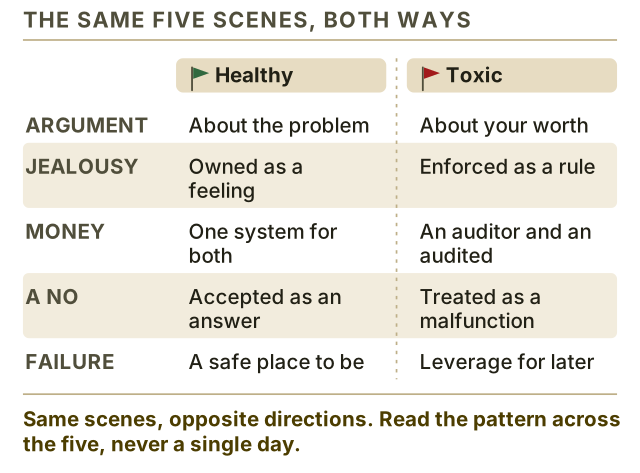
Toxic vs healthy relationship is a comparison of directions rather than adjectives: it asks whether a couple’s hard moments point at the problem or at the person. Most explanations of it hand you two adjective lists — trust, respect, communication on one side; jealousy, control, drama on the other — and leave you no better at recognizing your own life in either column. Adjectives don’t argue at midnight. People do. So this page does something more useful. It takes the same five ordinary scenes — an argument, a flash of jealousy, a money talk, a plain “no,” a failure — and plays each one twice, in its healthy version and its toxic version. The events are identical. The patterns are opposites.
One honest note before the scenes: every couple has toxic moments. Tired people say sharp things, sulk, keep score for an evening. A relationship earns the word “toxic” not by having those moments but by running on them. Watch for the system, not the scene. For the full anatomy of that system, see toxic relationship signs.
What is the difference between a toxic and a healthy relationship?
The difference is direction, not decibels. In a healthy relationship, conflict points at a problem: something is wrong, both people want it less wrong, and the argument — however loud — is a crude tool for getting there. In a toxic relationship, conflict points at a person: the question under every fight is who is to blame, who wins, and who owes. Healthy conflict spends energy and buys repair. Toxic conflict spends energy and buys ammunition for the next round.
That is why the same couple can look healthy on vacation and why a toxic dynamic can look calm for weeks. The tell is not the weather on any given day; it is what conflict does over time — shrink problems, or grow files on each other.
How does the same argument look in each version?
The scene: imagine a partner who forgot something that mattered — a plan, an errand, a date that was clearly important to the other.
| Healthy version | Toxic version | |
|---|---|---|
| Opening move | “That stung. Can we talk about it?” | “Of course you forgot. You always do this.” |
| The topic | Stays the forgotten thing | Migrates to character: careless, selfish, “just like your father” |
| The past | Stays in the past | Gets re-filed as evidence: every prior lapse returns |
| The ending | An adjustment both can name | A winner, a loser, and a quiet tab left open |
| Next week | The issue is smaller | The issue is stored |
The healthy version can still be loud. People raise voices, get defensive, need a break. What makes it healthy is that the argument stays about the argument, and that it ends in repair. Repair is the move that closes a conflict instead of storing it: an apology with no “but” attached, and a change you can actually observe later. That conflict between partners can be studied at all — by recording ordinary disagreements and following the same couples over years — comes from work like Gottman and Levenson’s 1992 paper on marital processes. That is a method of research, not a verdict on your last argument. The toxic version may even be quieter. Its signature is migration: the topic slides from the event to your worth, and the fight never truly ends, it just goes into storage.
How does jealousy look in a healthy vs unhealthy relationship?
The scene: consider an evening when one partner is out late with friends, including someone the other finds threatening.
Jealousy is a human feeling rather than a verdict, and not a red flag by itself. In the healthy version it gets handled as the jealous person’s own weather: “I felt weird about tonight. Probably my stuff. Can you just text when you’re heading home?” The feeling is owned, the request is small, and the evening out remains a normal thing to do.
In the toxic version, jealousy becomes an entitlement. The feeling is presented as proof of guilt: the questions come as an interrogation, the phone becomes evidence, the friend becomes a demand — stop seeing them. Notice the swap of responsibility. In the healthy scene, the jealous partner manages the feeling. In the toxic scene, the other partner must manage the feeling, by shrinking their life until it stops setting off alarms. When the shrinking becomes systematic — friends, money, movement — you have left “jealousy” and entered control; that pattern has its own page: signs of a controlling partner.
How does a money conversation look in each version?
The scene: let’s say one partner spent a noticeable amount without mentioning it.
The healthy version is boring, which is the point. Surprise, maybe irritation, then a process question: are we a check-in-first couple or a spend-your-own couple? The talk is about the system, both people get a vote, and the outcome binds both equally. Nobody’s spending is virtuous while the other’s is a character flaw.
The toxic version has an auditor and an audited. One partner’s purchases are always justified; the other’s are always evidence — of frivolity, of selfishness, of “why I have to manage everything.” Money talk arrives as a verdict, not a question, and the rules mysteriously apply in one direction. A double standard is a rule that applies in one direction only. One that always favors the same person is among the cleanest tells in this entire comparison, and it shows up in money earlier and more visibly than almost anywhere else.
What happens to a plain “no” in each version?
The scene: one partner declines something — sex, a party, a favor, a plan.
Healthy version: the “no” ends the transaction. There may be disappointment, even a visible sulk for an hour, because partners are allowed feelings about a refusal. But the “no” itself stays intact — it is not billed later, not renegotiated at midnight, not converted into a referendum on love.
Toxic version: the “no” starts a process. Guilt first (“after everything I do”), then pressure, then the ledger (“I never say no to you”), then cold weather until the “no” is withdrawn. The refusal is treated as a malfunction to be repaired rather than an answer to be accepted. If you notice you have simply stopped saying no — because the process costs more than the thing you were declining — that is not peace. That is the toxic version, fully installed. How a person treats “no” is also the single most portable test on this site; it anchors the healthy baseline in green flags in a relationship.
What happens when one of you fails in each version?
The scene: a real failure — a lost job, a botched plan, an embarrassing mistake in front of others.
In the healthy version, failure is a safe place to be. The couple closes ranks: the mistake can be named, even laughed about eventually, but the failed partner’s standing in the relationship never enters the negotiation. You can be unimpressive here and still be loved. That safety is not decoration — it is what the whole structure is for.
In the toxic version, failure is leverage. It becomes a story told at dinner parties with an edge, a card played in unrelated arguments, a reason you should be grateful they stay. The failed partner learns to hide struggles, which reads as distance, which becomes its own accusation. A relationship where you must be successful to be safe is not a partnership; it is a performance review that sleeps in your bed.
Is my relationship healthy? An honest way to check
Answer from the scenes, not from your mood on a good day. Which column did your last real argument follow — did the topic stay the topic, or did it migrate to who you are? When you said “no” recently, did it end the matter or start a process? When you failed at something, did you tell your partner first — or hide it from them first?
Two cautions on scoring yourself. First, mixed results are normal: real couples land in the healthy column most days and visit the other one under stress. The concern is residence, not visits — and especially trend, the same scenes drifting rightward over months. Second, this page describes patterns; it does not know your partner, and it cannot diagnose anyone. If your answers worry you, the useful next step is not a harsher label but a clearer baseline — spend time with the healthy kind so the comparison has a real reference point, not a remembered honeymoon. If you want the ordinary version described at book length, John Gottman and Nan Silver’s The Seven Principles for Making Marriage Work is a practical couples’ book built around repair. It is written about couples in general; it knows nothing about yours.
Where this page stops
A comparison page can tell you which column your scenes resemble. It cannot keep you safe, and some situations are past the point where reading helps. If you are afraid of your partner’s reactions; if your access to money, friends, family, or movement is restricted; if there has been any violence or threat of it — that is no longer a “toxic vs healthy” question. No checklist should be your next step. Talk to a professional, or contact a domestic abuse service in your country. Fear of the person you live with is the line. On the far side of it, the right resource is a human, not a page.