Most lists of signs of a controlling partner start at the loud end: forbidden friendships, confiscated cards, tracked phones. By the time control is that visible, nobody needs a list. The quieter problem — the one people actually search from — is earlier, when the behaviour still photographs well. Control at that stage rarely announces itself as control. It arrives dressed as attentiveness: text me when you get there. Who’s going? I just worry. Let me handle the money, you’re bad with stress.
Signs of a controlling partner are behaviours that narrow one person’s choices — who they see, where they go, what they wear or spend — while raising the price of resisting. This page describes them at their early, deniable stage, and the direction they tend to move. Two honest limits before the list. First, a pattern is not a verdict: this site describes behaviour, it doesn’t diagnose your partner, and it doesn’t know them. Second, there is a line past which this stops being a pattern question and becomes a safety question — that line is marked clearly at the end, and it is the most important section on this page.
What do the quiet signs of a controlling partner look like?
The early signs are behaviours that would each be reasonable once, becoming standing arrangements that only bind one of you. Watch for these shapes:
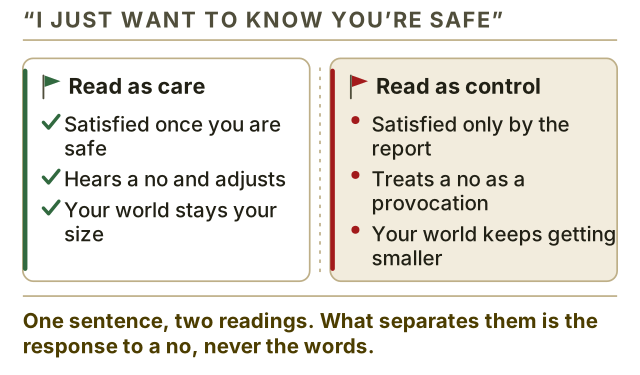
- Check-ins that became check-ups. “Text me when you land” is care. A required report of where you are, who’s there, and when you’ll leave — with irritation when the report is late — is monitoring. The observable difference: care is satisfied by your safety; monitoring is satisfied only by the information.
- Jealousy presented as a compliment. “I just love you so much I hate sharing you” reframes surveillance as devotion. What it means in practice: your ordinary contact with other people is treated as a cost your partner incurs and you owe repayment for. What it doesn’t mean: that occasional, owned jealousy is abuse — feeling jealous is human; enforcing it is the sign.
- Opinions that harden into rules. A partner is allowed not to like an outfit, a friend, a plan. The sign is what happens when you proceed anyway. If your choice stands and life goes on, that was an opinion. If proceeding costs you a sulk, an interrogation, or a scene, the opinion was a rule with the label peeled off.
- “I’ll handle the money” that you never chose. Couples divide tasks, and one person often runs the accounts. The sign isn’t who pays the bills — it’s access and visibility. If you don’t know what there is, can’t spend without permission framed as “just checking with me first,” or must justify small purchases while theirs go unexamined, the arrangement is not division of labour.
- A social calendar that needs approval. Not “we coordinate schedules” — everyone does that. The sign is asymmetry: your plans are subject to review, veto, or last-minute guilt (“go, I’ll just be here alone”), while theirs simply happen.
- An expensive no is the master sign underneath all the others. Declining — a call, a request, an opinion — reliably triggers something you have to manage: anger, wounded silence, a lecture, a debt to repay later. People adapt to expensive nos by not saying them, and from the outside that adaptation looks like agreement.
None of these, once, makes a controlling partner. All patterns on this site work the same way: an incident is information, a repeating incident with a direction is the thing itself.
Is it care or control?
The words alone can’t tell you, because the same sentence can be either — which is why “is my partner controlling or just caring?” is such a hard search to answer with a phrase list. “Where were you?” is care in one mouth and control in another. The reliable test lives in two places: what happens to your no, and what happens to your world.
For example, say no to a caring partner — “I’d rather go alone,” “I’m keeping my account separate,” “I don’t want to share my location” — and the no is absorbed. Maybe discussed, maybe disappointing, but absorbed. Say no inside a controlling pattern and the no becomes the new argument: why you’d want privacy if you have nothing to hide, why you’re so defensive, why you make them feel like a monster for asking.
And over months, care and control move your world in opposite directions. Care tends to leave you with more — more people, more confidence, more of your own life, plus the relationship. Control leaves you with less of everything except the relationship, which slowly becomes the only room in the house.
How does controlling behaviour escalate?
Gradually, and in an order that makes each step feel like a small extension of the last one you already accepted. Escalation means the widening of what falls under review here: first information, then access, then people, then resources, then movement. A common trajectory, described here so it can be recognised rather than predicted — no site can tell you what your relationship will do:
- Information. Where you are, who you’re with, what was said. Framed as closeness: couples share everything.
- Access. Passwords, location sharing, an open phone — often offered mutually at first, enforced one-directionally later.
- People. Specific friends become problems. Time with family becomes a negotiation. The objections always have reasons; the reasons always point the same way.
- Resources. Money, the car, the ability to work or study — reviewed, “simplified,” or handled for you.
- Movement and choices. By this stage the rules no longer need stating. You pre-comply, because you already know the price.
Two things make this trajectory hard to see from inside. Each step is deniable on its own — there was a reason, there’s always a reason. And your baseline resets: what you’d have called controlling in month one is just “how we are” by year two. That resetting is the same mechanism that makes home feel like a weather system you monitor; if that sensation is familiar, the page on walking on eggshells describes it from the inside. And when your objections to the pattern are met with rewrites — that never happened, you’re overreacting, everyone thinks you’re too sensitive — control is being defended with the machinery described in gaslighting in a relationship. The patterns reinforce each other: control shrinks your outside world, and a shrunken outside world has fewer witnesses to contradict the rewrite.
A note on a phrase from this search: “controlling personality types.” This site doesn’t sort people into types, and neither do checklists — personality is clinicians’ territory, assessed in a room with the actual person. You don’t need a type or a label to read the pattern in front of you. The behaviour is the evidence, and it’s the only thing you can observe directly.
How do you notice your world getting smaller?
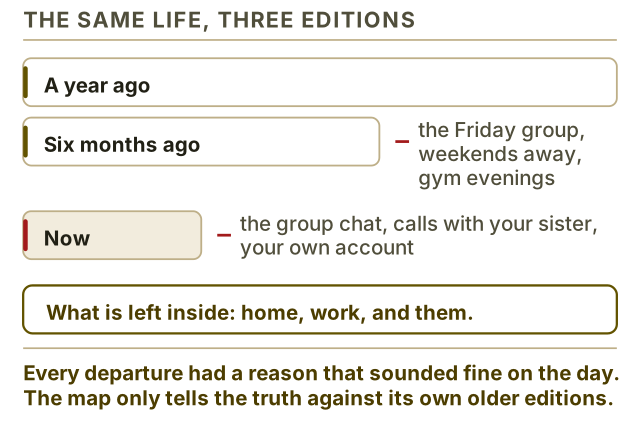
By comparing maps, not moments. Isolation is the shape that comparison reveals: not one dramatic ban, but a long run of small removals. Control almost never announces a removal. Each person, place, or account that leaves your life goes with a reason attached — the friend who was “a bad influence,” the class that “clashed with our evenings,” the account that was “simpler to merge.” In the moment, every removal is an argument you decided not to have. The pattern only becomes visible when you stand back and compare the whole map against an older version of itself.
So run the comparison deliberately. Take a year ago as your baseline and ask:
- People. Who did you see regularly then that you rarely see now? Who do you now see only with your partner present?
- Places and standing plans. The weekly game, the gym evening, the trips on your own — which still exist, and which quietly stopped being worth the negotiation?
- Money and logistics. What could you decide alone then — spending, travel, your own schedule — that now needs clearing first?
- The chats. Which conversations moved from daily to occasional to birthday-only?
A shrinking answer to one question means little; lives change shape for ordinary reasons, such as a new job, a house move, or a friendship that drifted on its own. The signature of control is that the answers shrink together, in one direction, and that every single loss has a reason that made sense at the time. Maps redrawn by life grow in some places while they shrink in others. A map redrawn by control only contracts.
What is NOT a sign of a controlling partner?
Keeping this category narrow protects real cases from being diluted, and protects ordinary relationships from being pathologised. It is not control when:
- A partner has preferences and says them. Disliking your ex being at the party, or a plan that wrecks a shared budget, is a stake in a shared life — as long as your decision can still go the other way and survive.
- A partner sets boundaries about themselves. “I won’t be in a relationship where X” governs their own participation. Control governs your behaviour. The direction of the rule matters.
- Couples coordinate. Sharing locations for logistics, discussing big purchases, knowing each other’s schedules — mutual, revocable, and symmetric arrangements are infrastructure, not surveillance.
- Someone asks for reassurance during a hard patch. Anxiety can look clingy without being controlling. The test, again, is the response to no and the direction over time: anxiety that’s owned and worked on loosens; control tightens.
- One bad, jealous evening happened. An episode that gets named, owned, and not repeated is an episode. This whole site runs on that distinction — the flagship page on toxic relationship signs draws the same line between moments and systems.
The direction of the rule is the whole distinction, and stating your own is harder than it sounds. The therapist Nedra Glover Tawwab’s Set Boundaries, Find Peace is written almost entirely around how to say the small version out loud. It is a book about phrasing, not a reading of your relationship, and no phrasing makes a punishing response safe.
Is it their control, or your own fear?
Honestly, from inside a long relationship, it is hard to call, and pretending otherwise would be dishonest. An anxious person can misread an ordinary partner. A controlled person is usually told, constantly, that anxiety is all this is. A few checks separate the two better than introspection alone:
- Locality. Your own anxiety travels with you — it flares at work, with friends, in past relationships. Fear that is a response to control is local: it concentrates around one person and eases in their absence.
- Symmetry. Count honestly: do they adjust plans, phrasing, and spending around your reactions as often as you do around theirs? Anxiety can exist inside a symmetric relationship. Control cannot — asymmetry is its structure.
- The imagined no. Imagine declining tonight’s expected thing — the call, the check-in, the plan. If what you feel is awkwardness, that points one way. If what you feel is dread of a specific, familiar consequence, you are not imagining a fear; you are remembering one.
- The out-loud test. Describe one incident, factually, to someone outside. If the telling itself feels like a betrayal you would have to conceal, notice that the secrecy was trained somewhere.
And one honest caveat in both directions: these checks sharpen the question, they do not settle it. Both things can also be true at once — living under control makes almost anyone anxious. The idea that your own anger is information rather than a defect gets a full treatment in Harriet Lerner’s The Dance of Anger, a book about the shapes two people settle into over time. It describes patterns in general, not yours, and it is not a reason to test anything you believe would be unsafe to test. A therapist of your own is the right room for untangling which is which.
What can you actually do with this — for yourself, not about them?
Notice what this page has not offered: a script to confront a controlling partner, or steps to make them change. That’s deliberate. Confrontation scripts assume a partner who fights fair, and the pattern described here is defined by punishing dissent — with some partners, a rehearsed confrontation is not just useless but unsafe. And “how to change them” is not your job, and not within your power. People change controlling behaviour when they own it and work on it, usually with professional help, over time. That work cannot be done for them from inside the relationship, least of all by the person the pattern targets.
What holds up instead is quiet and points at your own footing: keep a private, factual record of incidents while they’re fresh — for your own clarity, not as ammunition. Maintain or quietly rebuild one or two outside connections, because isolation is the pattern’s fuel. And watch what happens when the pattern is named calmly once: adjustment over time is information, and a more sophisticated version of the same rules is also information.
Where this page stops
This is the hardest boundary on this site, and this page is where it matters most, so plainly: some of what ranks as “signs of a controlling partner” in search results is not a red flag. It is abuse in progress. A website that let you keep reading pattern descriptions past that point would be doing you harm.
Stop treating this as a pattern question and talk to a person if any of the following is true:
- You are afraid of your partner — of their anger, of being punished for a wrong answer, of what happens when you get home.
- Your access to your own money is restricted or monitored: you account for spending, ask permission, or have no independent access at all.
- Your contact with your own people — friends, family, colleagues — is restricted, sabotaged, or punished, or you’ve given those people up to keep the peace.
- Your movements are tracked, limited, or require permission: where you go, when, with whom, whether you can work or study.
- There has been any violence or the threat of it — toward you, your children, or pets — including “only once,” including “they were drunk,” including property smashed to make a point.
Control of money, people, and movement is not a quiet sign of a future problem. It is the problem, already operating, and it is the environment in which leaving becomes hardest and most dangerous to do alone. This is beyond what any pattern-description site should be advising on. A therapist experienced with coercive relationships can help you think inside your specific situation. A domestic abuse service in your country can talk it through with you confidentially — including if you’re unsure whether your situation “counts” — and unsure is a perfectly good enough reason to call. You do not need bruises, certainty, or your partner’s agreement to be allowed to ask.
If you’re reading for someone else — a friend who keeps leaving early, checking their phone, shrinking — the most useful move is rarely an intervention about the partner. It’s staying present, asking once whether they’re okay, and being the connection the pattern hasn’t managed to cut yet.
For how this pattern relates to the others this site covers — the rewriting, the tension, the cycles — start at the patterns hub. Control rarely travels alone, and seeing the full map is often what makes the individual signs finally legible.