Walking on eggshells in a relationship is the state of monitoring your partner’s mood and editing your own words in advance to avoid setting them off. It is one of the few search phrases that describes the searcher, not the partner. People don’t type it because they read about a pattern somewhere; they type it because they caught themselves rehearsing how to ask about weekend plans, or standing in the hallway reading the sound of cupboard doors. This page describes that feeling from the inside — what it means, what it doesn’t, and what you can do that involves only you.
One limit stated up front, as everywhere on this site: a pattern is not a verdict, and a website cannot tell you what your relationship is. It can describe the mechanics precisely enough that you either recognise them or rule them out.
What does “walking on eggshells” mean in a relationship?
It means the ordinary business of living together — asking, disagreeing, mentioning, forgetting — has become risk management. You don’t just talk to your partner; you time it, phrase it, and pad it. The eggshell feeling is not fear of any single blow-up. It’s the chronic, low-grade vigilance of never being sure which reaction is coming, so you pre-edit everything to survive the worst case.
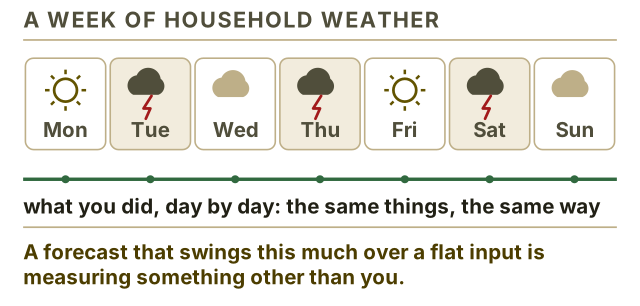
That’s why the phrase resonates even when nothing “dramatic” is happening. The defining feature is not shouting. It’s unpredictability plus consequences: the same sentence lands fine on Tuesday and detonates on Thursday, and you cannot find the rule that separates the two. When the rule can’t be found, people stop looking for the rule and start monitoring the person.
What does it actually feel like from the inside?
From the inside it rarely feels like a “pattern.” It feels like being considerate, then like being careful, then like being tired. People who live inside it describe the same small scenes — and consider how unremarkable each one looks on its own:
- You rehearse simple sentences. “Can we talk about the electricity bill” gets three drafts and a scheduled window, the way other people prepare for a salary negotiation.
- You scan mood from a distance. Footsteps, the weight of keys hitting the table, how the fridge door closes — you’ve become fluent in a language you never chose to learn.
- You brief other people. Before friends or family come over: don’t bring up work, don’t mention the trip, keep it light. You manage the audience so the weather holds.
- Good days feel like currency. A relaxed evening isn’t just pleasant — it’s capital, something you protect and spend carefully, because raising anything real would waste it. Many people realise they’ve been postponing an important conversation for weeks, waiting for a good day they’re then unwilling to sacrifice.
- Relief has a geography. You breathe differently in the car, at work, in the shower. Then the return home has a countdown feel to it.
None of these scenes is damning on its own. Together, pointed in one direction, over months — that’s the pattern this page is named after.
What does the rehearsal habit tell you?
That somewhere along the way, you collected evidence that first drafts are not safe here. People do not rehearse where spontaneity is cheap. Nobody scripts “we’re out of milk” for a partner who has never made an ordinary sentence expensive. The rehearsal habit is the drafting, timing, softening and pre-apologising you do before an ordinary sentence — not a personality quirk, but a record of past weather written into your speech.
Look at what the rehearsing actually optimises for and the dynamic describes itself. You are not polishing sentences to be clearer. You are engineering them for risk: choosing the hour, burying the request mid-paragraph, attaching a cushion of reassurance before and after. That is the grammar of someone negotiating with a reaction, not conversing with a person.
Two further things the habit can tell you, if you watch it closely:
- Where it switches off. Most people inside this pattern speak in easy first drafts with friends, colleagues, the barista — and shift into drafted speech at the sound of their own front door. The habit’s geography is a finding: it maps where the weather is.
- Whether it has started to travel. Long enough inside the pattern, some people catch themselves pre-editing everywhere — softening emails, rehearsing calls to friends who have never punished a sentence in their lives. That is not proof you were “the anxious one all along.” It is what an adaptation does when it generalises, and noticing it is information, not a flaw.
Is it normal to walk on eggshells sometimes?
Yes — as an episode, not as an address. Every long relationship has stretches where one person is grieving, burnt out, sick, or scared, and the other treads gently. Imagine a partner three weeks into a bereavement: you keep the volume down, you let small things go, you postpone the conversation that can wait. That’s care, and two things distinguish it from the pattern. First, it’s temporary and tied to a cause you could both name. Second, it runs in both directions over the life of the relationship: this year you carry them, another year they carried you.
The eggshell pattern fails both tests. The caution has no end date and no nameable cause you’d both agree on — or the cause is always you. And it flows one way: one person does the monitoring, the editing, the absorbing, while the other’s moods arrive unfiltered, like weather. If you try to remember the last time your partner rehearsed a sentence for you and can’t, that asymmetry is the finding.
Is it my anxiety, or is it the relationship?
This is the question underneath the search, and the honest answer is that a website can’t resolve it — but it can sharpen it. The useful test is location and history. Anxiety that is mostly yours tends to travel: it showed up in past relationships, at work, with friends; it flares about many things; it often persists even when you’re reassured. Eggshell tension tends to be local: it concentrates around one person, eases in their absence, and spikes at predictable triggers — their key in the door, their name on your screen.
There’s a second marker: what the fear is of. Relationship anxiety is mostly a fear of loss — that they’ll leave, that you’re not enough. The eggshell feeling fears reaction — anger, sulking, punishment by silence, the evening being ruined. Fearing that someone will stop loving you and fearing what someone will do are different experiences, even when they share symptoms like rereading texts and rehearsing conversations.
The two can also coexist, and one can feed the other; living with unpredictable reactions makes almost anyone more anxious over time. How adults handle distress inside a close relationship is a literature of its own — Mikulincer and Shaver’s open-access overview of the attachment research is one way into it. It describes a research tradition, not your household. That’s not a contradiction to untangle alone. It’s a good first question to bring to a therapist, who — unlike this page — can hear your specifics.
What does the eggshell feeling say about the dynamic?
It says the relationship has an unwritten rule: one person’s emotional reactions are a fixed force of nature, and the other person’s job is navigation. That rule is rarely announced. It’s trained — each blow-up, sulk, or icy evening teaches you a little more about what not to say, until the lesson generalises from “don’t raise the bill on a bad day” to “don’t raise things.”
Whether that training is deliberate matters less than people expect. Some partners cultivate it; others would sincerely say they never asked anyone to tiptoe — while never noticing that everyone does. This site doesn’t diagnose either kind. What can be said is where the feeling sits on the map. Chronic eggshells often overlaps with the quiet forms of control described in signs of a controlling partner. It overlaps with gaslighting in a relationship when your accounts of the blow-ups themselves get rewritten afterwards. It is also one of the core textures of the wider toxic pattern this site describes — not a bad moment, but a sustained direction.
One more thing the feeling reveals: honesty has become unaffordable. When every true sentence needs a favourable forecast, the relationship is running on managed information. That cost compounds quietly — in what you no longer mention, invite, attempt, or admit.
What is walking on eggshells NOT?
Keeping the definition narrow protects it, so the standing rule of this site applies here too. It is not the eggshell pattern when:
- You’re both careful during a genuinely hard season. A bereavement, a diagnosis, a redundancy. Care with an end date and a shared name is not eggshells.
- Your partner asks for specific, bounded consideration. “Please don’t joke about my weight” or “I need quiet the first hour after work” is a boundary you can learn once. Eggshells is precisely the absence of learnable rules.
- You feel nervous about one hard conversation. Dreading a specific talk about money or exes is human — for example, a first conversation about an ex neither of you has mentioned is awkward in any home. The pattern is when there’s no non-hard conversation left.
- You dislike conflict in general. Some people tiptoe in every relationship they’ve ever had. That’s worth working on — and it’s a different problem from a home that trained you into it.
The distinction matters in both directions. Inflating the phrase turns every considerate silence into evidence of abuse; keeping it narrow means that when it does fit, it can’t be waved away as “everyone’s careful sometimes.”
What does a calm home actually feel like?
Mostly, it feels like nothing — and that is the entire point. In a calm home, the key in the door is just a sound. Your body does not run a check when you hear it. Sentences get spoken in first draft, badly, and repaired mid-air without anyone paying for the repair. “We need to talk about the bill” is a sentence about a bill.
People who have lived inside the eggshell pattern for a long time often need this described, because their calibration is gone in a specific direction. They know what bad feels like, but they have quietly redefined good as “a day without incident.” A calm home is not the absence of conflict. Disagreement happens there too — the temperature rises, and then it comes back down, and the argument gets named afterwards instead of becoming a thing that never happened. What is absent is the monitoring: nobody is reading footsteps, timing requests, or briefing guests. How two people handle each other’s alarm systems from one day to the next is the whole subject of Stan Tatkin’s Wired for Love. It is a couples’ book about that ordinary work, written about partners in general rather than about anyone’s home in particular.
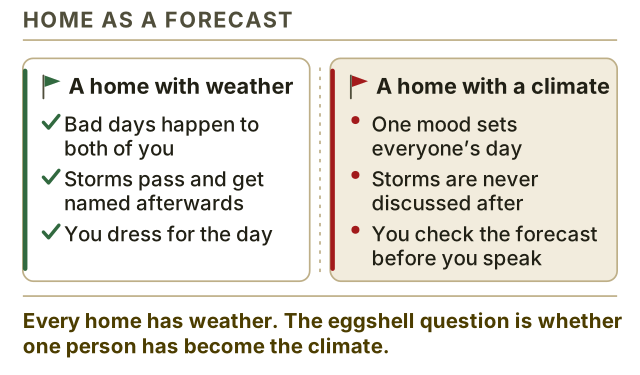
Two honest notes on the contrast. First, calm can initially feel flat to a nervous system trained on cycles — people sometimes mistake the absence of vigilance for the absence of feeling, because the spikes they called intensity were actually alarm. Second, this description is a calibration tool, not a stick to measure your partner with in one bad week. Every home has weather. What this page is for is remembering that homes where the weather is survivable — where you are a resident, not a forecaster — are not a fantasy. They are the ordinary thing this pattern slowly talks people out of expecting.
What can you do — with yourself, not your partner?
Notice the shape of that question. Most advice on this topic quietly becomes a manual for managing the partner better — softer openers, better timing. That’s more forecasting, and forecasting is the problem. What’s actually available to you, without any script and without waiting for anyone to change:
- Write the weather down. Privately, briefly, for yourself: what happened, what you didn’t say, what you edited. Not to build a case — to counter the slow drift where chronic tension starts to feel like normal life.
- Reintroduce outside air. Chronic eggshells shrinks worlds; time with people around whom you don’t rehearse is not a luxury, it’s calibration. If you notice you brief those people before they meet your partner, notice it in writing too.
- Run the both-directions test honestly. Over the last stretch of the relationship, who adjusted to whom? If the answer embarrasses you, that’s data, not a verdict.
- Get a room with a professional in it. A therapist of your own — not couples counselling first, especially if you’re afraid of your partner’s reactions, because a joint room can be one more place to manage the weather.
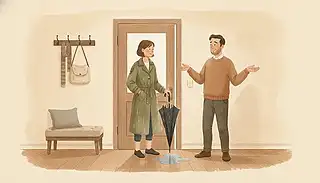
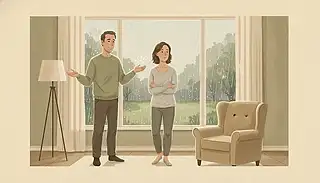
- Rebuild the comparison point. Long enough inside the pattern, people forget what unmonitored ordinary feels like. The toxic vs healthy side-by-side scenes on this site exist for exactly that: the same evening, in a home with weather and a home with a climate.
What you won’t find here is a script for confronting your partner about the pattern, and that’s deliberate. If the dynamic is what this page describes, confrontation scripts assume a safety that may not exist — and a person you have to script around is the finding, not the fix.
Where this page stops
This page describes a feeling and the dynamic behind it. For some readers, what’s behind the feeling is past pattern-language and into safety, and pretending otherwise would be dishonest. Stop reading articles and talk to a person if any of these is true:
- You are afraid of your partner — of their anger, their retaliation, or of what happens when you get something “wrong.”
- Your money, contact with your own people, or movements are monitored or restricted.
- There has been any violence or the threat of it — toward you, children, or pets — including punched walls and destroyed belongings.
Walking on eggshells because raising things is unpleasant and walking on eggshells because raising things is unsafe are different situations, and only you know which one you’re in. If it’s the second, a domestic abuse service in your country can talk it through with you even if you’re unsure it “counts,” and a therapist who works with relational abuse can help you plan around your specifics. You don’t need a label, proof, or your partner’s agreement to be allowed to make that call.
For how this pattern connects to the others this site names — control, gaslighting, the toxic cycle — start at the patterns hub. Eggshells rarely appears alone; it’s usually the felt texture of something with more structure behind it.