
Ask “what is gaslighting in a relationship” and most answers hand you a list of phrases. Phrases matter — there’s a whole page of gaslighting examples on this site — but the phrases are not the thing. The short answer to what is gaslighting in a relationship is a pattern over time: a repeated denial of your memory, perception, or feelings that slowly moves the burden of proof onto you for your own experiences. This page is about that mechanic — how a relationship gets from “we remember that differently” to the point where you stop trusting your own memory.
One honest limit before anything else: a website cannot tell you whether your partner is gaslighting you. It can describe the pattern precisely enough that you recognise it — or rule it out.
How does gaslighting actually work in a relationship?
It works by accumulation, not by any single dramatic scene. Each episode is small enough to dismiss on its own — a denied comment, for example, or a “you’re overreacting,” or a retold story where you come out irrational. What compounds is not the content of any one argument but the conclusion you’re pushed toward every time: that your read on reality is faulty.
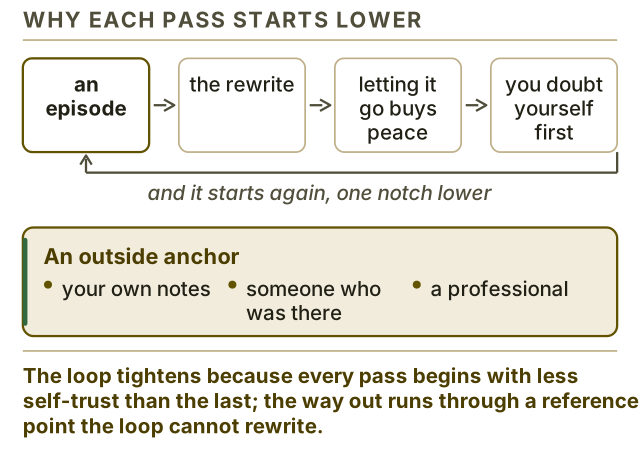
The sequence tends to look like this:
- An episode. Something happens — a promise, an insult, an agreement.
- The rewrite. When you bring it up, the event is denied, minimised, or reframed: it didn’t happen, it didn’t happen like that, or it happened because of you.
- The cost of insisting. Holding your version means a fight, a sulk, or a lecture. Letting it go means peace. Peace starts winning.
- The internal shift. After enough rounds, you skip the argument and go straight to doubting yourself. The rewrite now happens in your own head, pre-emptively.
That last step is the defining one. Gaslighting has worked not when your partner wins an argument, but when you stop bringing arguments because you’ve stopped trusting the perceptions that would start them.
Why do you end up doubting yourself instead of them?
Because the doubt is installed exactly where you’d need confidence to fight back. For instance, in most disputes you check your memory against your own sense of yourself: I’m not a person who imagines things. Gaslighting attacks that reference point directly. When the message “you misremember, you’re too sensitive, you make things up” comes from the person closest to you — the person who supposedly knows you best — it carries weight no stranger’s opinion could.
There’s also a plain asymmetry of effort. Doubting yourself is quiet and private. Doubting your partner means conflict, and possibly conclusions you’re not ready to face about the relationship itself. The mind often takes the cheaper option: maybe it really is me. That’s not weakness — it’s what most people would do inside the same pressure.
This is why the question “am I being gaslit?” feels so circular from the inside. The tool you’d use to answer it — your own judgment — is the thing under attack.
What role does isolation play?
Isolation is the pattern’s load-bearing wall. Your memory survives contact with other people: a friend who was there, a sister who says “no, you told me about that the same day,” a group chat with the receipts. Every outside witness is a threat to the rewrite.
So the pattern often travels with quiet pressure away from those witnesses. Your friends are “dramatic” or they “hate the relationship,” so seeing them gets harder. Your family “always takes your side, that’s why their opinion doesn’t count.” Recounting arguments to others becomes “betraying our privacy.” None of these moves looks like isolation on its own; each has a reasonable-sounding frame. The pattern is visible in the direction: fewer people who could confirm your version of events, more conversations where the only available reality is your partner’s.
If checking your perceptions with someone outside the relationship has started to feel like a disloyal act, that feeling is itself worth examining. This is where gaslighting overlaps with the broader mechanics described in signs of a controlling partner — the two patterns feed each other.
What is gaslighting NOT?
This site’s standing rule: a pattern is not a verdict, and not every bad conversational habit is gaslighting. It is not gaslighting when:
- Your partner genuinely remembers something differently. Two honest people can hold conflicting memories of the same evening. The test is not who’s right — it’s whether the disagreement stays a disagreement or becomes evidence that your mind can’t be trusted.
- Your partner disagrees with your interpretation. “I don’t think I was being cold, I was tired” is a different claim than “that conversation never happened.”
- Your partner says no, sets a boundary, or declines to apologise. Frustrating, maybe. Not reality-denial.
- Someone is defensive once, badly, in a heated moment. People say “that’s not what happened!” in panic. An episode is an episode. Gaslighting is the system those episodes would form if they repeated in one direction, with your self-trust shrinking along the way.
The reason this section exists: once the word entered everyday vocabulary, “gaslighting” started being used for any disputed account of events. That inflation cuts both ways — it makes real cases easier to dismiss, and it turns ordinary conflict into grounds for alarm. Keeping the definition narrow protects people in both situations.
Am I being gaslit — or am I the one who’s wrong?
The fact that you’re asking is not proof either way — but the shape of your doubt carries information. Consider the direction of change over the life of the relationship:
- Have you become less sure of your memory than you used to be, specifically around this person?
- Do you keep private records — notes, screenshots — not to win arguments but to reassure yourself that things happened?
- Do disagreements reliably end with your perception, character, or stability as the topic, rather than the original issue?
- Do outside people who hear your accounts react with confusion at how differently you tell the story now?
An honest person who is simply wrong about a fact will feel wrong about that fact. A person inside a gaslighting pattern feels increasingly wrong about themselves. If home has also started to feel like a place where you monitor moods and rehearse sentences, the adjacent pattern described in walking on eggshells may map onto your situation too.
What this page deliberately does not offer: scripts to confront or “shut down” the person doing it. Confrontation scripts assume a partner who argues fair; the pattern being described here is precisely a partner who doesn’t. What holds up instead is external and quiet — write things down for yourself while they’re fresh, keep or rebuild contact with people outside the relationship, and let at least one of them hear your unedited version of events. Saying the small version out loud — what you need, rather than what happened — is its own skill, and Nedra Glover Tawwab’s Set Boundaries, Find Peace is a therapist’s book written almost entirely around it. It is a book about your side of a conversation, not a description of anyone’s partner.
Why does keeping a private record help?
Because it moves your reference point outside the argument. A private record is a note you write for yourself, not for an argument. The pattern works by making your memory contestable in the moment — and a brief note, written the same day, is not contestable in the moment. It already exists. Not as evidence for anyone else: this is explicitly not about building a case or winning a future fight. The record is for the only audience the pattern targets — you, later, mid-doubt.
What it does in practice:
- It interrupts the pre-emptive rewrite. The final stage of the pattern is doubting yourself before any argument starts. A dated note from your own hand is the one witness that was there and has no stake in the retelling.
- It makes the pattern visible as a pattern. Single episodes are each dismissible. A month of short notes, reread in one sitting, shows the direction — the same move, the same ending — in a way no single evening ever can.
- It costs almost nothing. A line or two: what happened, what was said, what you edited out of yourself. Facts over feelings, because facts are what get rewritten.
One safety note belongs here rather than at the end of the page. If your partner monitors your phone or your accounts, keep the record somewhere they cannot reach — on paper away from home, or with a person you trust. A discovered record can be turned into a new episode, and your safety outranks your documentation.
What does getting your own memory back look like?
Quieter than people expect, and slower. There is no moment of restoration — what returns is a set of small abilities you may only notice in hindsight. You catch yourself saying “I’m sure” without the reflexive wobble after it. You stop rehearsing evidence before raising ordinary things. A disagreement stays the size of a disagreement instead of becoming a referendum on your stability. You reread something you wrote months ago and recognise your own account as an account, not a symptom.
Three honest things about that process:
- The doubt outlives the relationship. The checking reflex — was that real, am I exaggerating, should I ask someone first — keeps firing for a while. It goes on firing even after the person contesting your reality is gone or has stopped. That is not a sign the doubt was justified; it is what any trained habit does when the training ends.
- It rebuilds relationally, because it was damaged relationally. Self-trust rarely returns through willpower alone. It returns through repeated contact with people who hear your account and respond to it as information — friends who remember things with you, and often a therapist, because that is a room built for exactly this. That adults steady themselves through the people closest to them, rather than alone, is the premise of a long research tradition; Mikulincer and Shaver’s open-access overview in World Psychiatry is a readable way in. It describes a field of study, not your relationship.
- It is not the same as certainty. Recovered memory does not mean deciding you were right about everything. It means your own perception gets a vote again — the ordinary, fallible, correctable confidence that everyone needs to function, and that this pattern specifically taxes away.
Why do people gaslight?
There’s no single motive, and this site doesn’t diagnose anyone. What can be said carefully: the behaviour ranges from largely unexamined — a person who learned early that rewriting events is how you escape blame — to deliberate, where controlling the story is how they control the relationship. Some people do it under a self-image of being “the rational one,” genuinely convinced that your differing account is an emotional error to be corrected.
A note on a word you’ll meet everywhere in this search: “narcissist.” It’s the internet’s favourite explanation for gaslighting, and it may be why you’re reading. This site uses it only as a search term. Personality disorders are diagnosed by clinicians in a room with the person — not by websites, and not by partners with a checklist. More to the point: whether your partner would meet any clinical definition changes nothing about the question in front of you, which is the pattern and what it’s doing to your grip on your own reality.
The practical takeaway from motive is narrow. The less the behaviour is owned when named — the more that naming it produces a smoother version of the same denial — the less realistic it is to expect change from inside the relationship.
Where this page stops
This page describes a pattern. Some of what readers bring to this search reaches past patterns and into safety, and pretending otherwise would be dishonest. Stop reading articles and talk to a person if any of these is true:
- You are afraid of your partner — of their anger, their retaliation, or what happens if you get something “wrong” in their eyes.
- Your access to money, your own people, or your movements is monitored or restricted.
- There has been any violence or threat of it, toward you, children, or pets.
Those situations are beyond what a pattern-description site should be advising on. A therapist who works with relational abuse can help you think inside your specific situation. A domestic abuse service in your country can help too, even if you only want to talk through whether what’s happening “counts” at all. You don’t need certainty, a label, or your partner’s agreement about reality to be allowed to ask for that help.
For the rest of the patterns this site covers — and how they overlap — start with the hub. Gaslighting rarely travels alone.