
If you are searching for gaslighting examples, you probably do not need a textbook definition — you need to hear the phrases and check them against something that happened to you. Gaslighting examples are the ordinary-sounding lines that carry the pattern: flat denials, reclassifications of your reaction, appeals to a crowd you cannot question. This page gives you exactly that: the common lines, a scene showing how they work in sequence, and — just as important — what gaslighting is not. That last part matters, because the word gets used so loosely that it can turn ordinary disagreement into an accusation. A pattern is not a verdict, and this site does not know your partner. What it can do is describe the behavior precisely enough that you can recognize it, or rule it out.
What is gaslighting?
Gaslighting is a repeated pattern of denying another person’s memory, perception, or feelings until they start doubting their own mind. Not one dishonest argument. Not one “I don’t remember it that way.” The defining feature is repetition with a direction: over time, one person becomes less able to trust what they saw, heard, and felt without the other person’s confirmation.
That direction is what separates gaslighting from ordinary conflict. Two people can argue badly, misremember, even lie occasionally — and both still walk away trusting their own minds. In a gaslighting dynamic, one person’s grip on their own experience erodes while the other person’s version becomes the official record. It is one of the named mechanics covered across the patterns hub, and it rarely travels alone.
What are common gaslighting phrases?
The phrases below are the ones people report most often. Read them with one caution: any of these lines can be said innocently once. They become gaslighting examples when they are the routine response to you raising something real.
- “That never happened.” Flat denial of an event you clearly witnessed. Not “I remember it differently” — a full erasure, delivered with confidence, so that continuing to insist makes you feel unhinged.
- “I never said that.” The conversational version of the same move. Said often enough, it teaches you to stop quoting them back, because the quote will simply be denied.
- “You’re too sensitive.” Reclassifies the problem: the issue is no longer what they did, but your reaction to it. Your feelings become the defect under discussion.
- “You’re remembering it wrong.” Different from a genuine memory dispute. The tell is asymmetry: your memory is always the faulty one, and always in ways that favor them.
- “Everyone agrees with me.” Recruits an invisible jury. You cannot cross-examine “everyone,” so the claim works as pressure, not evidence.
- “You’re crazy.” Or “you need help,” said not with care but as a trump card that ends the conversation by disqualifying you from it.
- “You always make yourself the victim.” Flips the frame the moment you name a harm, so that naming it becomes the offense.
- “I only did it because you…” Not an apology with context — a transfer of authorship. Whatever happened, you caused it, so there is nothing for them to own.
Notice what these phrases have in common: none of them engages with the thing you raised. Each one relocates the problem into you — your memory, your sensitivity, your sanity, your motives.
What does gaslighting look like in a real scene?
Here’s an example: the same small event, told twice. No named characters, because this is a composite of how the pattern is commonly described, not a story about real people.
The event. Imagine that one partner makes a cutting remark about the other in front of friends. The other partner brings it up at home that evening.
A non-gaslighting version. “Ouch — yeah, that came out harsher than I meant. I was trying to be funny and it landed badly. I’m sorry.” There may still be a real issue here — a habit of jokes at your expense is worth watching. But notice: the event is not disputed, the reaction is not pathologized, and both people leave the conversation with their memories intact.
A gaslighting version. “What remark? I didn’t say anything like that.” — “I was sitting right there.” — “You’re doing this again. You twist everything into an attack on you. Ask anyone who was there, nobody else heard a problem. Honestly, the way you build these stories, I worry about you.” Follow the sequence: denial of the event, then reclassification of the reaction, then the invisible jury, then concern-as-weapon. The original remark is never discussed. What gets discussed is whether the person who raised it can be trusted to perceive reality.
One scene like the second version is a bad night. The same sequence, every time something is raised, for months — that is the pattern. How that pattern compounds into chronic self-doubt is covered in how gaslighting works inside a relationship.
How does gaslighting escalate over time?
It climbs a ladder, and the rungs are ordered by territory: first the event is disputed, then your character, and finally everyone else’s opinion of your mind. Few people would accept the top rung on day one. Each rung normalizes the next, which is why the climb is so rarely noticed from inside.
The typical sequence:
- “It didn’t happen like that.” Still shaped like a memory discussion. Deniable, plausible, and occasionally even true — which is what makes it a working first rung.
- “That never happened.” The dispute becomes erasure. No competing version is offered; the event is simply removed from the record.
- “You always twist things.” The subject changes from the event to you. Your pattern of perceiving is now the problem, so no single memory needs debating.
- “I’m worried about you.” Concern arrives as a weapon. It sounds like care, which makes resisting it feel like proof of the problem.
- “Everyone thinks you’re crazy.” The invisible jury. Your unreliability is no longer their claim — it is presented as the world’s settled consensus.
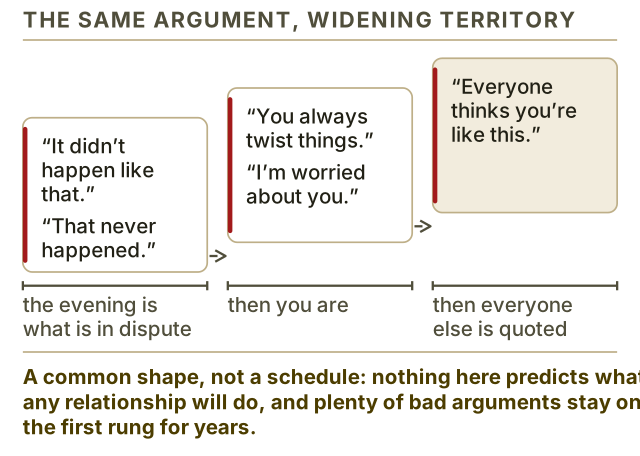
Two cautions. The ladder is a common shape, not a schedule — no site can predict what any relationship will do, and plenty of bad arguments live on the bottom rung forever without climbing. And the direction matters more than the altitude: what makes it gaslighting is not reaching rung five, but the steady movement of the conversation away from what happened and toward whether you can be trusted to perceive anything at all.
What is NOT gaslighting?
This section exists because the word is doing too much work lately, and a site about patterns owes you the boundaries of the pattern.
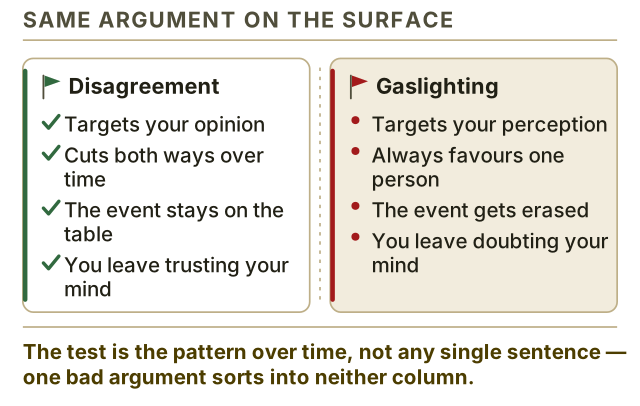
- Disagreement is not gaslighting. Someone can think you are wrong, say so bluntly, and be sincere. Gaslighting denies your perception of events, not your opinion.
- A different memory of a small thing is not gaslighting. Two honest people routinely remember the same dinner differently. The tell is direction and stakes: honest memory conflicts scatter randomly; gaslighting conflicts consistently favor one person.
- “No” is not gaslighting. A partner declining something, holding a boundary, or refusing to keep re-litigating a settled argument is not denying your reality.
- Forgetting is not gaslighting. People genuinely forget conversations. Frustrating, sometimes a real problem — but forgetting lacks the confident rewriting that defines the pattern.
- A single lie is not gaslighting. Lying is its own problem. Gaslighting is a campaign against your confidence in your own perception, and a campaign takes time.
Which phrases sound similar but are not gaslighting?
Several honest sentences share vocabulary with the phrases above, and the difference is worth spelling out, because accusing someone of gaslighting over an honest sentence is its own kind of unfairness. The test in every pair: the honest version leaves the event standing and argues about something else. The gaslighting version removes the event, or removes you as a credible witness to it.
- “I remember it differently” is not “That never happened.” The first admits two versions exist and implicitly allows yours. The second declares there is nothing to have versions of.
- “I think you’re overreacting to this” is not “You always overreact.” The first is an opinion about one reaction — arguable, maybe wrong, but bounded. The second reclassifies you, so that every future reaction arrives pre-dismissed.
- “That’s not what I meant” is not “That’s not what I said.” Clarifying intent accepts the words were spoken. Rewriting the words erases the record itself.
- “I don’t want to argue about this again” is not “You’re obsessed with this.” A boundary about a conversation is not a diagnosis of the person trying to have it.
- “You’ve been really anxious lately” — said with care, about something real — is not “You’re crazy.” The difference is function: one opens a conversation about you, the other ends a conversation about them.
Several of the left-side sentences are limits said plainly, which is its own difficult skill — Nedra Glover Tawwab’s Set Boundaries, Find Peace is a therapist’s book written almost entirely around how to say the small version out loud. It describes your side of a conversation, not the other person’s motives.
If your partner’s sentences reliably fall on the left side of these pairs, you are likely looking at ordinary, imperfect conflict. It is the right-side versions, repeated as a routine, that build the pattern this page describes.
How can you tell if it is happening to you?
Track the direction of doubt, not individual sentences. Consider a few questions to sit with:
- After hard conversations, do you trust your memory more or less than you used to?
- Do you find yourself rehearsing evidence before raising anything, because you know the event itself will be contested?
- Are your memory failures oddly one-sided — always about things they did, never about things that inconvenience you?
- Have you started needing their confirmation before believing your own experience?
If several of those land, it does not prove anything about your partner’s intentions — this site cannot see inside your relationship. But it does mean the dynamic deserves attention. Gaslighting often overlaps with broader control of decisions, contacts, and information; the quiet early forms are described in signs of a controlling partner. And if the main thing you recognize is the constant tension of managing someone’s reactions, that feeling has its own page: walking on eggshells.
Why doesn’t this page teach you to “shut down” a gaslighter?
Because the honest answer is that confrontation scripts mostly do not work here, and can make things worse. Someone who repeatedly denies your reality will usually process a confrontation through the same machinery: the confrontation itself becomes new evidence that you are unstable, obsessive, or coached by whoever you talked to.
The one move reliably available to you is your own, not theirs. That idea — anger as information, and a pattern two people settle into together — runs through Harriet Lerner’s The Dance of Anger, which is about the dance in general, not yours in particular.
What stays within your power does not involve winning the argument:
- Keep a private record for yourself. Not to litigate with — to give your future self an anchor when your memory of events is being contested.
- Borrow an outside mind. A friend, family member, or counselor who hears your account without a stake in rewriting it. Isolation is the pattern’s best friend.
- Decide based on the pattern, not the promise. The question is not “can I finally make them see it,” but what this dynamic costs you and what you want to do about that.
Where this page stops
This page describes behavior. It cannot tell you whether your partner is gaslighting you, and it will not pretend otherwise. And there is a line past which this stops being a reading topic. You are past what any article can responsibly help with if any of these is true:
- You feel afraid of your partner.
- They control your money, your contact with people, or your movements.
- There has been any violence or threat of it.
In that case, talk to a professional, or to a domestic abuse service in your country. Reaching out is not an accusation and not a commitment to any decision — it is information from people trained to help you think clearly, which is exactly what this pattern takes away.