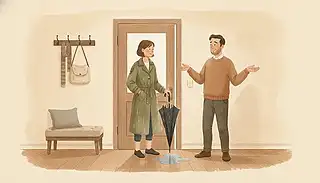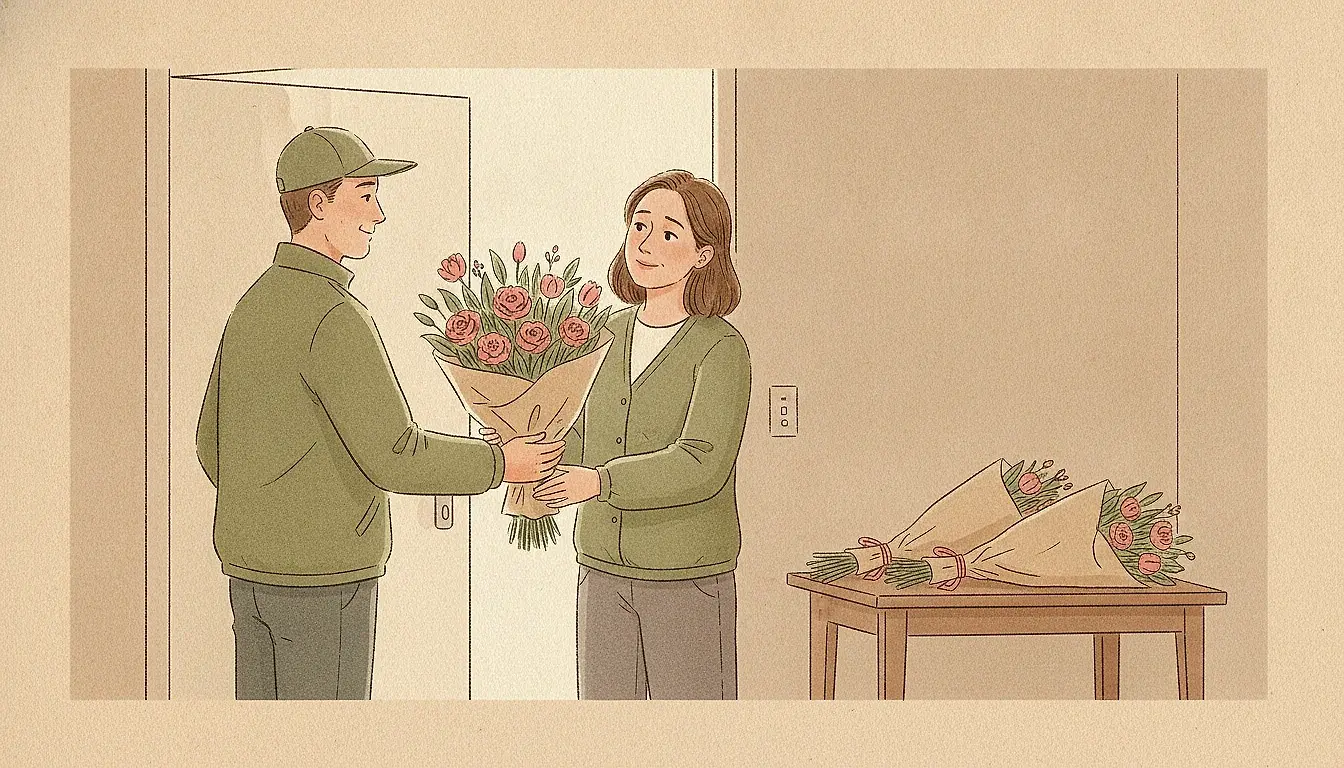
Most articles about love bombing define it. This one shows it. Love bombing examples are the concrete scenes a definition leaves out — texts, gifts, and rushed timelines — and each one below carries the same honest question: why is this pressure and not just enthusiasm? Because that distinction matters. Falling for someone hard is not a red flag. Punishing them for having a life outside the relationship is.
One rule for reading this page: no single scene here proves anything about a person. A pattern is a shape that repeats. One extravagant bouquet is a bouquet.
What does love bombing actually look like?
In real life, love bombing looks like a relationship running at fast-forward: constant contact, early declarations, big gestures, and a plan for the future before there is a present. What makes it a pattern rather than a whirlwind romance is the enforcement layer underneath. When one person tries to slow the tempo, the response is hurt, guilt, sulking, or a doubling of the gestures.
Consider a few recognisable scenes.
- The instant schedule. Within the first week or two, every evening is spoken for. Declining a night out with friends produces visible disappointment, then a grander invitation that is harder to refuse.
- The biography download. Deep, flattering attention: they remember everything, ask everything, mirror your taste in music and your opinions. It feels like being seen. The flag appears later, when that archive of details is used to argue you two are uniquely fated, so hesitation becomes irrational.
- The public claim. Couple photos, meet-the-family plans, or social-media official-ness proposed before you have privately decided what this is.
What this does not mean: an attentive, fast-moving start is not automatically a trap. Some good relationships begin intensely. The observable difference is the reaction to a boundary, which is why every example below ends at the same checkpoint.
What are examples of love bombing texts?
Love bombing texts are affectionate on the surface and obligating underneath. The message says adoration; the meta-message says respond, reassure, comply. Here’s an example set, paraphrased rather than quoted from anyone real:
- The full-day pipeline. Good-morning paragraph, midday check-in, evening recap, goodnight essay. Sweet in isolation. It becomes a flag when a slow reply triggers “you okay? did I do something?” within the hour, so your silence is now a problem you must manage.
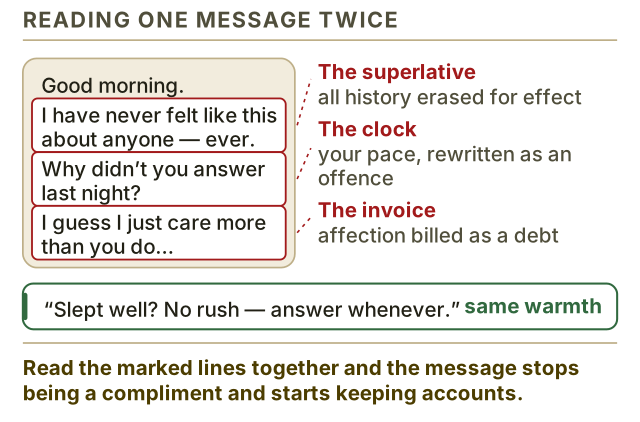
- Instant-destiny language. “I’ve never felt this way about anyone.” “I knew the moment I saw you.” “You’re my soulmate” — in week one. The words are not the issue; people gush. The issue is that destiny framing makes your caution sound like sabotage of something cosmic.
- The loyalty probe. “You’d tell me if you were talking to other people, right?” before exclusivity was ever discussed. It converts a normal early-dating reality into a confession.
- The guilt attachment. “I guess I care more than you do” after a slow evening. This is the clearest tell in texting: affection that invoices you.
Why this is pressure and not warmth: warm texting survives a quiet afternoon. A person who simply loves texting will notice you were at work and move on. A love bombing pattern treats every gap as a debt. If the same message rhythm continued happily after you said “I can’t text much at work,” it was just a texting style. Texting habits in general are covered in early red flags when dating, because the first month is where this pattern is most visible and most deniable.
When do gifts become love bombing?
Gifts become love bombing when they are disproportionate to the relationship’s age and carry an implied invoice. Generosity gives and lets go. Bombing gives and keeps the receipt.
Recognisable versions:
- The escalation gift. You mention offhand that you like something; a luxury version arrives days later. Once is thoughtful. As a system, it teaches you that every casual remark becomes an obligation-generating event.
- The apology bypass. After the first friction — a cancelled plan, a small disagreement — a grand gesture appears instead of a conversation. The gift closes the topic. Over time, problems stop being discussable because they are always purchasable.
- The declined-gift test. You say “this is too much, please don’t.” Watch what happens. Acceptance and adjustment: generosity. Hurt, insistence, or “you’re the only person who’d complain about being treated well”: pressure.
- The retroactive ledger. Weeks later, in an argument, the gifts return as evidence: after everything I’ve done for you. This is the moment the earlier generosity reveals its function.
What this does not mean: a partner with money and a gift-giving habit is not running a scheme. Plenty of people over-give out of nerves or culture or plain delight. The test is not price. It is whether “no, thank you” is a safe sentence.
Saying that small sentence out loud is harder than it reads, and it has a literature of its own. Nedra Glover Tawwab’s Set Boundaries, Find Peace is a therapist’s book built almost entirely around how to say the small version out loud. It is a place to go next, not a description of anyone you are dating.
Why do some gifts feel like they arrive with a meter running?
Because they are not presents — they are advances. A present transfers completely: it is yours, the giver lets go, and the books close on the thank-you. An advance is a payment made before delivery, and what it quietly purchases is future relationship: gratitude on schedule, access, the next milestone. The meter starts the moment the box is opened, and you can feel it running even when you cannot yet name it.
That felt sense is worth trusting, because it is observable in your own behaviour before it is ever provable in theirs. The tells that a gift was an advance:
- You hesitated to accept it, and the hesitation had to be managed — talked away, overridden, made into a small scene about your gratitude.
- You felt relief when you reciprocated, as if a balance had been restored rather than a kindness enjoyed. Presents do not produce balances.
- The gift stays in circulation. It gets referenced — playfully at first — when you decline something, slow something down, or spend an evening elsewhere.
- Its size tracks the relationship’s milestones, not your tastes. Advances get larger exactly when commitment is being negotiated.
None of this convicts a generous partner; plenty of people simply love giving, and the books genuinely close. The distinction is not the price tag or the frequency. It is whether the giving ever gets cashed.
What does a love bombing timeline look like?
The love bombing timeline is commitment outrunning knowledge: milestones that usually take months are proposed in weeks, and hesitation is treated as a wound. You may hear folklore online about exact schedules — how many weeks bombing “always” lasts, which date the mask “always” drops. Those numbers are folklore. No one has a stopwatch for this. What repeats is the sequence, not the dates:
- Sprint. Exclusivity, meeting family, key exchange, holiday plans, or moving-in talk — early, and framed as proof of seriousness. “When you know, you know” does the arguing.
- Checkpoint. At some point you ask to slow down. This is the single most informative moment in the whole pattern. An enthusiastic-but-healthy partner is briefly disappointed and then adjusts. A bombing pattern reframes your pace as rejection: sulking, cooling, or an accusation that you are “not as invested.”
- Turn. If the pattern continues, the intensity that was aimed at you gets aimed against you. The person who could not go a day without you is now distant, critical, or gone. Devaluation and the abrupt exit are the two common exits; the FAQ below covers the ghosting version.
Again, the honest complication: infatuation also moves fast, feels cosmic, and says embarrassing things. The timeline alone cannot convict anyone. The checkpoint can — not as a verdict on the person, but as information about the pattern you are inside.
What is not love bombing?
Enthusiasm, generosity, fast attachment, and heavy texting are not love bombing on their own. This word is currently doing too much work online, and a page of examples owes you the counter-list:
- Matched intensity is not bombing. If both people are texting constantly and planning trips in week two, and both could slow down without punishment, that is a fast start, not a pattern.
- A gift is not bombing. Neither is a love letter, an early “I love you,” or meeting friends soon. Awkward pacing is human.
- Anxious reassurance-seeking is not the same thing. Someone who double-texts out of insecurity and then respects “I need slower replies” has a nervous habit, not an enforcement system. The distinction lives, as always, in what happens after the boundary.
- You will not find a diagnosis here. Search results tie love bombing to the word “narcissist.” Personality disorders are diagnosed by clinicians in a room with a person, not by websites reading a text thread. This page describes behaviour, because behaviour is what you can actually observe.
Why some people move fast at all is a separate question, with a popular-audience literature of its own. Amir Levine and Rachel Heller’s Attached sets out how adults differ in what closeness and distance feel like. Read that way, speed on its own reports a style rather than a motive — which is why every example here ends at the boundary instead.
The most reliable contrast is not a list of bad signs but a picture of the good version: affection that leaves room. That comparison lives at green flags in a relationship, and it is worth reading next, because pattern-spotting without a healthy baseline curdles into paranoia.
What do people say about it afterwards?
Afterwards, the accounts converge — and the convergence is the useful part. These are not quotes from anyone real. They are the recurring shapes of how people describe the pattern once they are outside it, generalised rather than reported:
- “It felt like being the main character.” The retrospective rarely denies how good the bombardment felt. That honesty matters: the pattern works because the experience is genuinely pleasurable, not because the person was foolish.
- “I mistook the volume for depth.” The most common single realisation: constant contact felt like being known, but the knowing never actually accumulated. The attention was loud, not close.
- “They were in love with the milestone, not with me.” Looking back, the intensity tracked the commitment schedule — exclusivity, the introductions, the keys — more than it tracked anything specific about the person receiving it.
- “The one who couldn’t live without me lost interest in a season.” The abrupt temperature drop reads, in hindsight, as the sales period ending rather than a feeling dying.
Retrospect sees what the present tense cannot, because the meter has stopped and the accounting is finally visible. If you are using this page mid-relationship, that is the one advantage you can borrow: the questions above are askable now, not only afterwards.
If this page feels personal
If you recognised your relationship in several sections, the useful next step is observation, not confrontation. Note the checkpoint moments: what happened the last few times you said no, asked for space, or slowed the pace? A pattern will show itself in that record faster than in any list of examples.
Where this page stops
This page describes a pattern and shows examples of it. It cannot tell you what is happening in your relationship, and it is not therapy or a substitute for it.
One boundary this site holds everywhere: if the intensity has shaded into monitoring, or into control of your money, contacts, or movement, that is beyond what a pattern glossary should advise on. The same goes if you feel afraid of your partner’s reaction to ordinary choices. When what you recognise is fear rather than frustration, a page is the wrong tool. Talk to a professional, or to a domestic abuse service in your country.
The rest of the named mechanics — including where intensity overlaps with control — are mapped in the patterns hub.