
The first month of dating is the easiest time to miss a red flag and the best time to catch one. Easiest to miss, because everyone is on their best behavior and you want it to go well. Early red flags when dating are the repeats that surface in low-stakes moments: a delayed reply, a changed plan, a small no. That is why the first month is also the best time to catch them — no shared keys, no shared friends, no shared rent yet to complicate the picture.
One framing before the lists. This page is not a scorecard for judging strangers. What early dating actually reveals is not whether someone is a “good person” — nobody can see that in four weeks — but how they treat your boundaries when the cost of respecting them is small. That single lens covers almost everything below. For the wider system behind it, see the honest red-flags checklist.
What can early red flags actually tell you?
They can tell you about patterns, not character. In the first month you are watching a stranger respond to small tests that life runs automatically: a text answered late, a date rescheduled, an opinion they disagree with, a quiet “not tonight” at the end of an evening. A red flag at this stage is a repeated response to those moments — not one bad answer on one tired evening.
That distinction protects you in both directions. It stops you from excusing a pattern (“he only gets like that when he’s stressed” — every week), and it stops you from prosecuting a moment (one clumsy joke on a nervous first date is data, not a verdict). Behavior described here is a pattern to watch, not a diagnosis of the person doing it.
What are the red flags in texting, before you meet?
The texting stage previews one thing with surprising accuracy: how the person handles not getting instant access to you. Watch for these, always as repeats rather than one-offs:
- Guilt over response time. “Wow, busy day?” as a jab, not a question. For instance, you reply in three hours and get a sulk that takes a day to repair.
- Location and status checks. “Who are you with?” from someone you have met once is not care; it is an early bid for monitoring.
- Escalation past your redirect. You steer away from a sexual topic and it comes back the same evening. The topic is not the flag — the override is.
- Intensity that arrives before knowledge. Future-faking is talk about a shared future — moving in, holidays, the rest of your life — offered to a person they cannot yet describe. Alongside it: “I’ve never felt this way,” soulmate language, a pace set entirely by them. That script has a name, and it is worth reading about love bombing before deciding what to make of it — intensity itself is not the test; the reaction to “slower, please” is.
- Punishing silence. You set any limit and the warm stream of messages goes cold until you apologize for the limit.
What this stage does not reveal: texting frequency preferences, humor mismatches, or slow replies from a person who told you they reply slowly. Different rhythm is compatibility information, not a warning. How much contact a person wants early on varies enormously, and Amir Levine and Rachel Heller’s Attached is the popular-audience account of the attachment styles behind that variation. It is a book about people in general, not a reading of the person texting you.
What are the first date red flags?
The first paragraph answer: the biggest first date red flags are contempt and pressure — how the person treats people who can do nothing for them, and what they do when you decline something small.
Consider what a single evening can show:
- The waiter test, honestly applied. Rudeness to staff matters not because it is a famous line, but because it shows how they treat someone with less leverage. You will eventually be the person with less leverage in an argument.
- All exes were crazy. One difficult ex is a life. A gallery of villains with no reflection on their own part is a preview of how your chapter will be narrated.
- Your no gets negotiated. One more drink after you said you’re done; a venue change you declined that happens anyway; a goodnight that requires an exit strategy. The size of the request is irrelevant — the override is the flag.
- The interview goes one way. They collect your details — job, address, salary, past — while deflecting every question about themselves. Curiosity is mutual; extraction is not.
- You feel relief when it ends. Not butterflies-versus-no-butterflies, which is unreliable, but a body-level relaxation once you are alone. Worth writing down before the follow-up text rewrites the memory.
What a first date does not reveal: nervous rambling, awkward silences, an over-rehearsed compliment, splitting-the-bill etiquette handled gracelessly. Anxiety mimics several flags for one evening. Patterns need a second scene.
What shows up only in the first month?
Time is the instrument here. Some patterns cannot appear on a first date because they need repetition to exist at all. The first paragraph answer: what the first month adds is the gap between words and actions, and the trend line of your own behavior around this person.
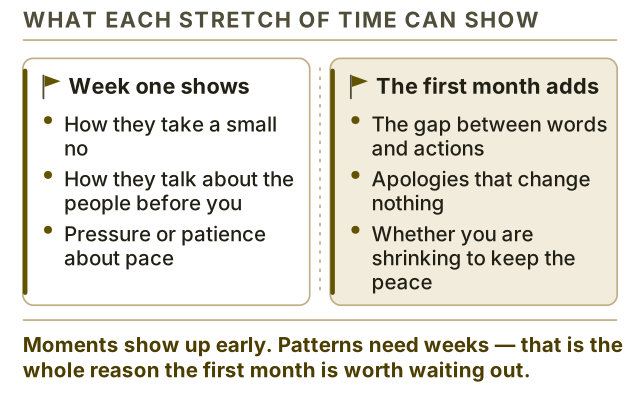
Concretely, the first month is where you can finally see:
- The apology loop is an apology that arrives on schedule while the behavior stays where it was. Anyone can apologize once; the month shows whether apologies change behavior or replace it.
- Boundary re-testing is a limit you stated in week one going “forgotten” in week three. Once is memory; twice with the same limit is a probe.
- Consistency across audiences. Imagine someone charming with you, dismissive of a friend, cold to family on the phone. The version that appears under no effort is the durable one.
- Your own trend line. The quietest early red flag lives in you: rehearsing texts before sending, editing opinions, feeling watched rather than seen. If your world is contracting in month one, the direction matters more than any single incident.
If you find yourself pattern-matching everything and trusting nothing, recalibrate against the opposite picture — what green flags actually look like. Without a model of healthy, every ambiguous moment reads as a threat, and that is its own way of losing the plot.
Are the 3-3-3 and 3-6-9 dating rules real?
Answer first: no — they are folklore. These numbered formulas circulate through social media as pacing rules for new relationships, and the specific stages change depending on who is retelling them. No clinical body defines them, and this site treats their numbers as folklore, not findings. Where a real research tradition exists it has a paper trail: the idea that adult couples run on the same attachment machinery as children and caregivers comes from Hazan and Shaver’s 1987 paper. That is provenance for an idea, not a rule about your fourth date.
The instinct underneath them is sound, which is why they spread: pacing is a real diagnostic. Someone can perform a persona for a while; nobody performs indefinitely; slowing down costs a genuine person very little and a controlling one a great deal. You do not need a numbered rule to use that. State your pace once, plainly, and observe what happens. The reaction to “slower” is worth more than any formula built around it.
When should you walk away early?
Answer first: walk away when a clearly stated boundary gets deliberately tested again, when you catch yourself consistently managing their reactions instead of enjoying their company, or immediately if anything frightens you. Early dating is the one stage where leaving is cheap — no shared history, no entangled lives — and “this isn’t working for me” is a complete sentence that needs no case file attached.
What you do not owe: a confrontation, a detailed indictment, or a chance for them to argue you out of your own read. Ending things early on pattern evidence is not paranoia. It is the entire point of paying attention early.
For the broader map of what to watch beyond the first month, start at the Spotting it hub.
Where this page stops
This page describes patterns, not people. Nobody here has met your date, and an article cannot tell you what is happening in your relationship. It is also not therapy, and not a substitute for it.
Talk to a person, not a page, if what you recognize is fear rather than frustration:
- You are afraid of their reactions — of anger, or of retaliation.
- Your money, your own people, or your movements get monitored or restricted.
- There has been any violence or threat of it.
That is no longer a dating question, and a checklist is the wrong tool for it. A professional, or a domestic abuse service in your own country, is the right one. You do not need certainty or a label to be allowed to ask.