Red flags in a girl are patterns that repeat, not moods that pass. They work exactly the way they work in anyone. This page is the mirror of our guide to red flags in a guy, written to the same standard with its own examples, because behaviour does not have a gender even though search queries do. The point is not to hand you a scorecard for the woman you are dating. The point is to help you tell the difference between a bad afternoon and a preview.
One more honesty note before the list: we do not know your girlfriend. A page can describe behaviour. It cannot tell you who someone is.
What counts as a red flag in a girl?
A red flag is a repeated behaviour that predicts how you will be treated once the early effort wears off. Three parts matter: it repeats, it has a direction (things get sharper, not softer), and it has a price you are already paying, usually in how carefully you have started to speak around her.
That definition quietly excludes most of what gets called a red flag online. Different taste, an awkward first date, a past you were not part of — none of that predicts anything. “I felt small after we talked, again” does.
What are the early red flags worth watching?
Early flags show up in small, observable places, not dramatic ones. These are the patterns worth attention in the first weeks:
- Every ex is a villain, every friendship ends in betrayal. One bad ex is a life. A full cast of monsters, told with relish, usually says more about the narrator than the cast. Listen for whether anyone in her stories is ever allowed to be complicated.
- “I hate drama,” delivered mid-drama. Watch the gap between the label and the behaviour. Someone who genuinely dislikes conflict de-escalates. Someone who narrates herself as drama-free while feuds multiply is telling you how future conflicts will be framed: as everyone else’s fault.
- Your no is treated as an opening bid. For example, you decline something small — a plan, a purchase, a party — and it becomes sulking, a guilt tour, or a joke at your expense until you fold. How a person handles a small no is the cheapest preview you will ever get of how she handles a big one.
- Jealousy is staged, not felt. Mentioning other guys to watch your reaction, testing you with manufactured silence, keeping a rival vaguely in frame. Feeling jealous is human. Deploying jealousy is a tactic.
- Contempt in front of an audience. Teasing that lands as mockery, correcting you publicly, “I’m just being honest” as a licence. Affectionate teasing survives the question “does she do this when it costs me something?” Contempt does not.
- The scoreboard is the habit of logging favours and archiving mistakes so that old errors return with interest during new arguments. Generosity that generates debt is not generosity.
- Apologies never quite happen. “I’m sorry you feel that way” and “I wouldn’t have to if you didn’t” are not apologies; they are counterclaims. Notice whether repair after a fight is ever her move, or always yours.
None of these, once, ends a relationship. Any of them, as a rhythm, is information.
Is jealousy or “testing” always a red flag?
The feeling is not; the system built on it can be. Jealousy that gets named and handled (“I felt weird when that happened, can we talk about it”) is ordinary. Jealousy that arrives as surveillance — phone checks, quizzes about your day, friends you are quietly discouraged from seeing — has stopped being a feeling and become management.
The same test applies to loyalty tests. Loyalty tests are attempts to learn by trick what could be learned by asking, and a person who runs them has decided that tricking you is the more reliable route. That belief tends to outlast the honeymoon. If checking has already extended to your messages, your money, or where you are allowed to go, skip ahead to the last section of this page, because that is no longer a dating question.
What is NOT a red flag in a girl?
Privacy, a past, boundaries, and a no are not red flags, and this half of the page matters as much as the list above. A boundary is a limit someone sets about her own life, not a wall built against you. Consider a woman who does not hand over her phone password: she is not hiding something, she has said where her privacy ends. A dating history is not a warning label. Needing an evening alone is not rejection. Being direct is not aggression.
How much closeness a person wants, and how quickly, varies more than early dating advice usually admits. Amir Levine and Rachel Heller’s Attached is the popular-audience account of adult attachment styles, and it is a useful corrective if early intensity or early distance is the only thing you have to go on. It describes styles in general. It says nothing about the woman you are seeing.
Pattern-spotting without a picture of the healthy version curdles into paranoia, where every boundary reads as a scheme. If the list above made you nervous about normal behaviour, read the green flags guide next; it is the calibration this page depends on.
What about the “top 10 red flags” lists?
The round numbers are folklore. Lists of ten red flags, five signs, or a magic count of flags that means “run” are a content format, not a finding, and this site does not use them. Counting also fails at the practical level: three trivial flags matter less than one pattern of contempt, so the score tells you nothing the pattern had not already told you.
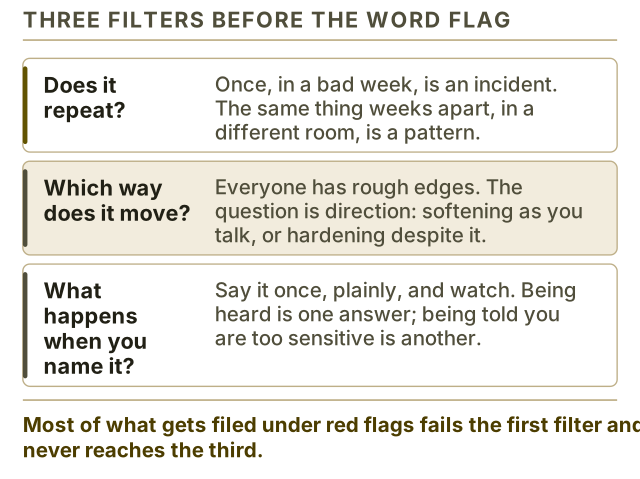
What replaces counting is direction. Ask whether the behaviour is getting softer or sharper over time, and whether you can raise it without punishment. Those two questions outperform any list.
What should you do with one red flag?
One flag is a conversation; a pattern is a decision, and both belong to you, not to her. Let’s say something on this page happened once: you can name what you saw and watch what happens next. A person worth staying with can hear “that stung” without turning it into a trial. How she receives the observation is itself the best data you will get.
What we will not offer is a plan to change her. Pages that promise scripts to fix a partner are selling something that is not for sale. Your options are about your own position: raise it, watch the response, widen your sample with time, or leave. If you are still in the first weeks, the early red flags timeline covers what a reasonable watching period looks like, and the rest of the Spotting it hub covers the same ground from other angles. Changing your own move in a pattern rather than trying to change hers is the subject of Harriet Lerner’s The Dance of Anger, which treats anger as information about the pattern two people have settled into.
Where this page stops
Some of this moves past patterns into fear: you are afraid of her reactions, your access to money, friends or movement is restricted, or there has been any violence or threat of it. If that is where you are, this page is the wrong tool, and so is any page. That applies regardless of gender; men in this position often hesitate longer because they doubt they will be believed. Talk to a professional, or contact a domestic abuse service in your country. Pattern-spotting is for dating decisions. Safety is a different category, and it comes first.