
Red flags in a guy are repeating behaviours that show how he handles cost — a no, a bill, a person who can’t push back. They are easiest to spot before you’re invested, which is exactly when most people aren’t looking. This page covers what shows early: the first conversations, the first dates, the first time you say no. It describes behaviour you can observe, not character you’d have to guess at.
One honest note before the list. Red flags don’t have a gender. This page exists because this is how people search, and the examples fit that search — but the same standard applies in the mirror page about red flags in a girl. Nothing here means “all men”. It means: if you’re dating a guy, here is where the early signal usually hides.
What counts as a red flag in a guy?
A red flag is a repeating behaviour that points somewhere, not a single moment you didn’t like. “He was quiet at dinner” is a data point. “He goes cold every time I have plans without him” is a pattern with a direction. The flag is the pattern.
That distinction does real work. Anyone can have a bad evening, be awkward, or say something clumsy on a second date. A red flag needs repetition, a consistent direction (toward control, contempt, or pressure), and a cost that lands on you. One without the other two is just a person being a person.
It also cuts the other way: a red flag is not a verdict. Noticing one doesn’t obligate you to leave, and it doesn’t make him a villain. It obligates you to keep your eyes open instead of explaining it away.
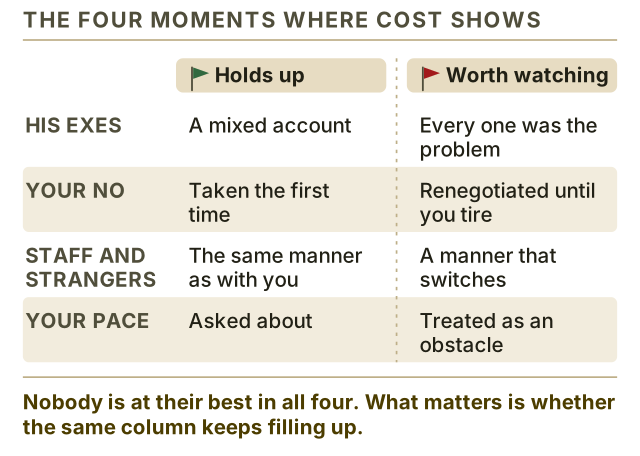
How does he talk about his exes?
Listen for one specific move: is every ex the villain of the story? “All my exes are crazy” is one of the most reliable early tells, because it’s not really a claim about the exes — it’s a preview of how your chapter gets told if things end.
A man who can say “we wanted different things” or “I handled that badly” is showing you he can hold two sides of a story. A man whose history is a parade of unstable women who wronged him is showing you a pattern with one common element, and it isn’t them.
What this doesn’t mean: having one genuinely difficult ex, or not wanting to discuss old relationships on a second date. Privacy is normal. A universal villain narrative is not.
How does he handle your “no”?
This is the highest-value test the early weeks give you, and you don’t have to engineer it — life supplies it. Imagine an ordinary few weeks: you’re tired one night, busy one weekend, unwilling to do something. Watch what happens next.
A clean response sounds like acceptance without a bill attached. The flag versions are renegotiation (“come on, just this once”), sulking that you’re expected to fix, guilt (“I guess I just care more than you do”), or treating your no as a personal insult. Each one says the same thing: your boundary is an obstacle to route around, not a fact to respect. A boundary is a statement about what you will and won’t do — not an opening offer, and not a mood to be argued out of.
Disappointment is not a flag. He’s allowed to wish you’d said yes. The flag is when disappointment becomes pressure, and pressure becomes your problem to manage.
How does he treat people who can’t push back?
Consider how he is with the people he has no reason to impress: waiters, drivers, junior colleagues, his mother on the phone. This is the classic advice for a reason: how he treats people he doesn’t need to impress is closer to his default setting than how he treats you in month one.
Early dating is a performance — mostly a sincere one, but a performance. Charm aimed at you is filtered. Contempt aimed at a waiter is not. If the charm switches off the moment someone has nothing to offer him, you’ve seen the switch, and you should believe it exists.
What this doesn’t mean: one short reply to a waiter on a stressful night, or social awkwardness, which can look like coldness and isn’t. You’re looking for contempt as a pattern — enjoyment of the power gap — not a single flat interaction.
Is he pushing the pace?
Speed itself isn’t the flag — some couples genuinely move fast and are fine. The flag is how he responds when you ask to slow down. “Slower” is a boundary, and you already know what a flag around boundaries looks like.
Pressure to be exclusive before you’ve met his friends. Big declarations that outrun what he could actually know about you. Irritation when you want more time. This cluster has a name, and it works as a pattern, not an event. Love bombing refers to intensity used as leverage — attention and speed arriving before he could know you, then withdrawn or turned into pressure the moment you ask for time. The full mechanics are in the love bombing page; the short version is that intensity can be a tool for extracting commitment before you’ve seen enough to consent to it.
The test is simple and fair: say “I’d like to take this slower” and watch. Saying that sentence out loud is harder than it reads, which is the subject of the therapist Nedra Glover Tawwab’s Set Boundaries, Find Peace — a book written almost entirely around the small version of a request. Relief or easy agreement is green. A wounded reaction that you end up apologising for is the answer to a question you hadn’t asked yet.
What shows on the first few dates?
Less than you’d hope, more than you’d think. You won’t see his conflict style or his jealousy on date two — those need time and friction. What you can see is his reaction to small friction, such as a changed plan, a split bill, a topic you decline, or a joke that doesn’t land.
| Looks like | Worth noting when it repeats |
|---|---|
| “My exes were all crazy” (told as charm) | A one-villain history — preview of your future chapter |
| Curt with the waiter, warm with you | The charm has an off switch tied to usefulness |
| “Why do we need to wait?” after a slow-down ask | Your pace treated as an obstacle, not a boundary |
| Teasing that stings, defended as “just a joke” | Your discomfort reframed as your flaw |
| Sulking after a small no | Refusal has a price you’re expected to pay |
Notice what’s not on that list: nervousness, quietness, a boring story, disagreeing with you about a film. Early dating punishes awkwardness far more than it punishes actual warning signs, and it’s worth keeping the two apart. The fuller week-by-week version of this lives in early red flags when dating.
What does one red flag actually mean?
It means: pay attention, don’t panic. A single flag is information about a possible direction. A repeating flag is an answer about the actual one. The move in between isn’t a confrontation or an ultimatum — it’s watching whether the small version grows or shrinks over time, and being honest with yourself about which is happening.
Two things help keep this calibrated. First, know what good looks like, so pattern-matching doesn’t slide into paranoia — that’s the point of the green flags in a guy page. Green flags are the ordinary behaviours that hold up under friction: a no taken cleanly, an apology that changes something, warmth that doesn’t depend on who is watching. Second, remember whose behaviour this page is about. It ends with options for you: keep watching, slow down, step back. It deliberately offers no method for changing him, because that isn’t a reader’s job, and pages that promise it are selling something. The alternative — changing your own move inside a pattern two people are keeping going — is the subject of the psychologist Harriet Lerner’s The Dance of Anger, which treats anger as information rather than as a fault.
Where this page stops
This page is about early signals in ordinary dating. Some things are past its edge, and naming that edge matters more than any list above.
If you are afraid of him; if he controls your money, your contact with people, or where you go; if there has been any physical intimidation or violence — that is not a red flag to weigh. That is a safety situation. Please talk to a professional, or to a domestic abuse service in your country. A website that describes patterns is the wrong tool for that moment, and this one knows it.