
Most pages about red flags in a relationship are lists: dozens of behaviors, each framed as a reason to run. This page takes a different position. Red flags in a relationship are patterns rather than items on a checklist — a behavior that repeats, a direction it travels in, and a price you pay for naming it. The same behavior can be a flag in one relationship and noise in another, and the difference is not in the behavior itself. It is in what happens after you name it.
This site describes behavior. It does not diagnose people, and it does not know your partner. What it can do is give you a way to tell an off day from a pattern — and tell you plainly where a website stops being the right tool.
What is a red flag in a relationship?
A red flag is a repeating behavior that predicts how a partner will treat you when it costs them something. Not what they do on a good day, when being kind is free — what they do when you say no, when you succeed, when you are away, when they are wrong. A single bad evening is information. The same behavior coming back after you have named it is a flag.
That definition does real work, because it separates a red flag from “I didn’t like this.” Plenty of things are worth not liking, such as a joke that landed badly, a preference you don’t share, or a habit that grates. Those are compatibility questions, and adults negotiate them. A red flag is different in kind, not just degree — it points somewhere. It says: this is how disagreement will go here, this is what your no will cost, this is what happens to your side of the story.
So before anything else, run one filter. Is this a behavior that repeats and trends in a direction? Then keep reading. Is it a one-off you’re still upset about? Then it may deserve a conversation, but it does not yet deserve the word flag.
Which red flags mean leave now?
A short list of behaviors are not “watch and wait” material. Any physical violence. Threats of violence — against you, themselves, or anyone you love. Intimidation is violence aimed at the room instead of at you: punching walls, breaking your things, blocking doorways, driving dangerously to scare you. Threats tied to your leaving. These are not flags on a pattern that might improve; they are the pattern, already arrived.
Two things about this category. First, it does not require repetition to count. The definition above — pattern over incident — is for the ambiguous middle, and this category is not ambiguous. Second, it is exactly the point where a website is the wrong tool. If any of this is present, the useful next step is people, not pages: someone you trust, a professional, or a domestic abuse service in your country.
Everything below this line assumes this category is absent. If it is not, stop reading lists and start telling someone.
Which red flags mean watch the pattern?
Most of what people search for lives here: behaviors that are sometimes serious and sometimes human, where the honest answer is “watch the direction, not the incident.” The flag is never the single scene. It is the trend across scenes, and above all the response to being named. The idea that you learn more from how a couple argues than from what they argue about is not new: it comes out of a research tradition that recorded couples’ conversations and followed them over time. Gottman and Levenson’s 1992 paper is one of the papers that built it. That is a way of studying couples, not a verdict on yours.
Jealousy that becomes supervision. Feeling jealous is human. A partner who owns the feeling — “I got weird about that, it’s mine to handle” — is doing the work. The flag is jealousy converted into your obligations: share your location, explain that coworker, answer faster. When “I feel insecure” becomes “so you must shrink,” direction matters more than intensity. If the checking spreads to money, friends, or where you can go, that is no longer jealousy — read the notes on signs of a controlling partner, because that page draws a harder boundary than this one.
Criticism that becomes contempt. Couples criticize each other; healthy ones criticize behavior. The flag is when criticism migrates to your character — you’re lazy, you’re crazy, you’re lucky I’m here — and especially when it picks up an audience or a sneer. Contempt says the other person is beneath you. Complaints negotiate; contempt ranks. Watch which one is growing.
Secrecy that has a shape. Privacy is normal — nobody owes a partner every password and every thought. The flag is secrecy with a pattern: a phone that flips face-down for one person’s messages, a category of evenings that never gets described, stories that change when details are checked. The test is not “do they tell me everything” but “do the omissions cluster.”
Your no has a price. Possibly the most predictive item on this page. Consider a small, legitimate no — a plan you decline, a request you turn down, a purchase you won’t make — and watch what happens. Sulking that lasts days, guilt delivered on schedule, affection withdrawn until you reverse yourself: that is a training program, and you are the one being trained. How a person treats your no early on is covered in more depth in early red flags when dating, because it shows up long before anything else does.
The story where everyone else was crazy. How a partner narrates exes, former friends, and old bosses is a preview of your future chapter. One genuinely awful ex is a life. A gallery of villains with no reflection — “every single one was insane” — is a pattern with one common element. The gendered versions of this and its cousins get their own treatment in red flags in a guy; the mechanics are the same in any direction.
Your reality gets renegotiated. Arguments where you leave less sure of what happened than when you entered. “That never happened.” “You’re remembering it wrong, again.” Everyone misremembers details; the flag is a system where your memory is always the faulty one and the correction always favors the same side. If this one is familiar, it has a name and its own pages on this site.
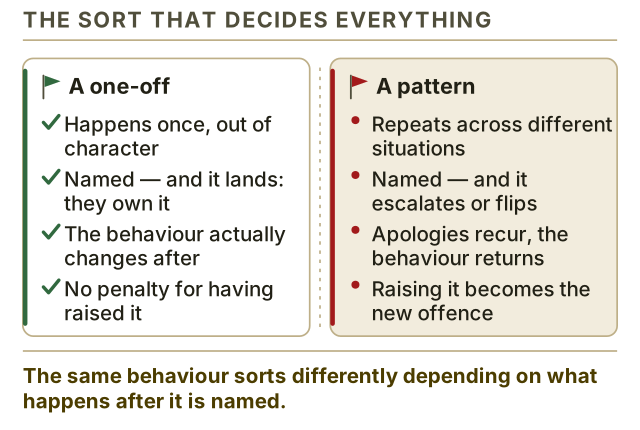
Why is a list of red flags not a verdict?
Because a list has no context, and context is where the meaning lives. A behavior on a list is a photograph; a red flag is a film. For example, “checks their phone constantly at dinner” could be a distracted week at work or the edge of an affair — the list cannot tell you, and neither can this site. What tells you is repetition, direction, and response.
There is also a failure mode on the reader’s side worth naming: with a long enough list, every relationship fails. Pattern-matching without a picture of health drifts into scanning a good partner for evidence. That is why the honest companion to this page is not more flags — it is green flags in a relationship. Green flags are the ordinary behaviors that show a relationship working under stress: an apology that changes something, a no that costs nothing, a version of events you both recognize. If you cannot describe what passing the test looks like, every result reads as failing.
And one boundary this site holds everywhere: patterns are not diagnoses. Describing a behavior as controlling or manipulative is not the same as declaring what a person is. Diagnoses come from clinicians who have met the person — not from websites, and not from partners armed with vocabulary.
What should you do about one red flag?
Talk about it — plainly, once, about the behavior. Not a courtroom, not an ambush with a list: one specific thing, what it does to you, said in a calm hour. Naming a request rather than a mood is the hard part. There is a whole literature about it — the therapist Nedra Glover Tawwab’s Set Boundaries, Find Peace is built almost entirely around how to say the small version out loud. A single flag in an otherwise respectful relationship is a conversation topic, not a sentence. People have bad seasons, old habits, blind spots they genuinely have not seen.
Then watch what the conversation buys. This is the real test, and it is worth stating exactly: the response to being named is more diagnostic than the behavior itself. A partner who hears it, sits with it, and adjusts — even imperfectly — is showing you the machinery of repair. Repair is the ordinary work of coming back after getting something wrong: naming it, changing the behavior, and not charging you for having raised it. It is the thing long relationships actually run on. A partner for whom the naming becomes the new crime — now you’re attacking them, now you owe the apology — has answered a bigger question than the one you asked.
One honest caveat: this applies to the ambiguous middle, not the leave-now category. There is no conversation to have about violence or threats, and no script on any website makes confronting an intimidating partner safe. That is professional territory.
What should you do about a pattern?
Stop negotiating with the behavior and start deciding about the relationship. This is the shift most people make too late: once naming a pattern reliably makes it worse, more conversations are not data collection — they are the pattern running. You already have your answer; the remaining question is what you do with it.
Notice what this page is not saying. It offers no plan for changing a partner, because you do not have one of those. Adults change when they decide to, on their own engine, and “I can love this out of them” is the most expensive sentence in this genre. Your options are about you: what you will live with, what you require to stay, whom you tell, when you go. Framing it that way is not coldness — it is the only frame in which you actually have moves.
If deciding feels impossible because your judgment itself feels foggy — you cannot tell anymore whether it is bad or you are oversensitive — that fog is worth taking seriously as a signal in its own right. Borrow outside eyes: a friend who knew you before, a therapist, anyone whose read on reality is not part of the dispute.
Where this page stops
This page is for noticing patterns and deciding what they mean. It stops being the right tool at a specific line, and honesty requires drawing it clearly.
If you are afraid of your partner — afraid of their reaction to a conversation, to a no, to this page open in your browser. If they control your money, your contacts with people, or where you can go. If there has been violence or threats of it, toward you or anyone. None of that is a red flag to watch; it is a situation to get help with. A professional who works with relationships, or a domestic abuse service in your country, will do what no checklist can: look at your specific situation and help you plan safely.
There is no shame at that line. Noticing it is the entire skill this site exists to teach.