“Toxic” may be the most overworked word in the relationship vocabulary — it now covers everything from an annoying habit to genuine abuse, which makes it nearly useless for the person actually asking the question. This page tries to give toxic relationship signs their meaning back. The short version: toxicity is not about how bad the fights are. It’s about whether the relationship is a system that keeps producing the same harm — and which direction that system is moving.
Toxic relationship signs are the repeating mechanisms in how a couple handles conflict and closeness, not the worst thing either person has ever said in a bad week. The standing rule of this site applies here more than anywhere: a pattern is not a verdict, and nobody who hasn’t met your partner can label your relationship. What a page can do is describe the patterns precisely enough that you either recognise them or rule them out.
What actually makes a relationship toxic?
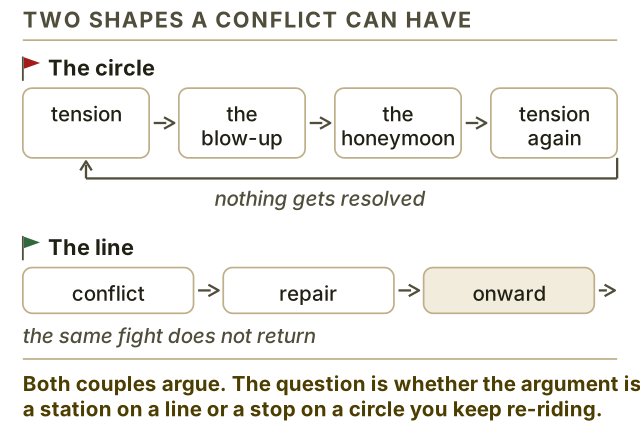
Repetition in one direction. Every couple has ugly moments — a cruel word in a fight, a week of coldness, a jealousy flare. A moment tells you almost nothing. A toxic relationship is one where the moments are not exceptions but output: the same conflict, the same wound, the same aftermath, cycling on a schedule, with no version of the loop where anything is actually resolved.
That’s why counting incidents misses the point. The question is not “how many bad things happened” but “do bad things here resolve, or do they recur?” Repair is the difference: something is said, something is understood, behaviour shifts, and the same fight doesn’t come back in the same form. A healthy relationship metabolises conflict that way; a toxic one recycles it. If you could write this month’s biggest argument on a card and reuse the card next month without edits, that’s the signature.
That conflict behaviour can be studied by watching couples talk, rather than by asking them afterwards how it went, is an old idea in the research. John Gottman and Robert Levenson’s 1992 paper in the Journal of Personality and Social Psychology is one of the papers built on that method. It describes a line of research, not your kitchen table.
What are the signs of a toxic relationship?
The signs worth taking seriously are mechanisms, not moods. Four show up again and again, and each is observable in ordinary weeks, not just in blow-ups:
-
Scorekeeping. Past grievances are stored, not settled. Apologies happen, but nothing is ever actually closed — old failures resurface as ammunition in new arguments. The relationship has a ledger, and the ledger only grows. The tell: you can’t remember a conflict that ended with the topic genuinely retired.
-
Silence as punishment. Withdrawal is used as a tool. Not “I need an hour to cool down” — that’s regulation, and it’s healthy — but days of coldness deployed to make you feel the consequence of displeasing them, ending only when you’ve paid in apology or pursuit. The tell is the function: the silence isn’t for calming down, it’s for making you earn the way back.
-
Blame with a gravity field. Whatever happens, fault lands in the same place. Their outburst happened because you provoked it; your hurt feelings happened because you’re too sensitive. One person is permanently the problem, the other permanently the reasonable one. If you’ve stopped bringing things up because every conversation about their behaviour somehow ends as a review of yours, that’s this sign.
-
The blow-up / honeymoon cycle. Tension builds, something explodes, then comes warmth — real-feeling warmth, sometimes the best days of the relationship. Then tension starts building again. The reconciliation phase is what keeps people in the loop, because it feels like the “real” relationship returning. But if the sweetness only ever arrives after damage, it’s not a recovery — it’s a phase of the same cycle.
Notice what’s not on this list: raised voices, arguing often, needing space, disliking each other’s friends. Those can appear in healthy and unhealthy relationships alike. The four above are structural — they describe how the relationship processes conflict and closeness, which is where toxicity actually lives.
How does the ledger actually work?
The ledger is a running store of grievances held as assets rather than settled as problems. Settling a grievance — genuinely accepting the apology, retiring the topic — would zero the balance, and the balance is leverage. So nothing fully closes. Apologies are received, even graciously, and then quietly logged rather than spent.
You can watch the mechanism in ordinary weeks:
- The ledger only opens during conflict. Old failures are never mentioned on calm days; they appear precisely when a present-day argument needs reinforcement. That timing is the tell — a real unresolved hurt aches at random; an asset gets deployed.
- Arguments start in the present and end years back. A dispute about tonight’s plans somehow closes with a ruling about who you have always been. The current issue was never the point; it was the occasion for an audit.
- Repayment has no schedule and no receipt. You can concede, apologise, change the behaviour — and discover the entry is still on the books, because the debt was never meant to be payable. A payable debt would end the leverage.
- Both people can keep one. This is a toxic-dynamic mechanism, not a villain’s tool. Plenty of couples run two ledgers at once, each side sincerely experiencing itself as the creditor. That mutual bookkeeping is exactly what makes the cycle feel unwinnable from inside.
For instance, imagine an apology accepted warmly on a Tuesday and then quoted back as evidence in an argument months later. The acceptance was a filing, not a closure.
The reusable-card test from earlier on this page applies here in miniature: try to recall one conflict that ended with the account genuinely closed. In a healthy dynamic that memory is easy to find. Where the ledger rules, there is no such thing as a closed account — only entries that have not been useful lately.
Is it toxic, or just a rough patch?
Bad periods happen in healthy relationships — this page would be dishonest without saying so plainly. Ordinary causes, such as illness, grief, a brutal work year, or a new baby, can produce months where two decent people are short-tempered, distant, and worse to each other than they want to be. If “we’ve been awful to each other lately” automatically meant toxic, every long relationship would qualify at some point.
The difference is direction and shape. A rough patch is a bad stretch with a cause you can both name, one that bothers both of you and bends toward repair — imperfectly, slowly, but the trend line moves. A toxic pattern has no external cause to point to, tends to bother one person much more than the other, and repeats rather than resolves. Rough patch is a line going somewhere. Toxic is a circle.
A useful private test: imagine the stressor gone. If you can honestly say “without the money pressure, we’d be us again,” you’re probably describing a patch. If the honest answer is “the stress just gives the same old fight a new topic,” the stressor isn’t the pattern — it’s the costume the pattern is wearing this season.
Am I in a toxic relationship?
A page can’t answer that — but it can tell you where to look, and it’s not at your partner first. Look at the direction of change in you across the life of the relationship:
- Are you more yourself around them than you were early on, or less?
- Do you trust your own judgment more than when you met, or less?
- Has your world grown — friends, interests, confidence — or contracted?
- Is home somewhere you rest, or somewhere you perform?
Healthy relationships are not free of conflict, but they run in one recognisable direction: over time, both people become more — more secure, more themselves, more able to be wrong without disaster. The toxic direction is the mirror image: over time you become smaller, more careful, more edited. If you find yourself rehearsing simple sentences before saying them, that specific experience has its own page. So does reading the emotional weather before deciding whether tonight is safe for a normal conversation — walking on eggshells maps closely onto this one.
The clearest way to check your read is comparison, because from inside a long pattern, the pattern feels like normal. The side-by-side scenes in toxic vs healthy relationship exist for exactly this: the same argument, the same jealousy, the same “no,” played out both ways.
What’s the difference between toxic and abusive?
Toxic describes a dynamic; abuse describes power and fear — and the distinction matters because the advice is different. A toxic dynamic is usually mutual in some degree: both people feed the cycle, both are harmed by it, and both would need to change it. Abuse is not mutual. It has a direction: one person controls, the other is controlled; one person is feared, the other is afraid.
The working line is fear and control. If your partner monitors or restricts your money, your contact with your own people, or where you go, you are no longer reading about a toxic dynamic — whatever word you searched. The same is true if you are afraid of their anger, or of what happens when you get something “wrong.” Control in particular is easy to misfile as intensity or care, especially early; the quiet forms of it are laid out in signs of a controlling partner, and they escalate.
This isn’t a pedantic vocabulary point. “Toxic” framing suggests couple-level fixes — communication, counselling, mutual work. Applied to an abusive situation, that framing is not just wrong, it can be dangerous, because it hands the controlled person half the blame and keeps them working on a dynamic that only one person is driving.
What happens when you name the cycle out loud?
Naming the cycle — calmly, once, as a shape rather than an accusation — is the cheapest diagnostic available from inside a toxic dynamic. Something like: “I think we do a loop. Tension builds, something blows up, we have a sweet week, and then it starts again — and the same fight keeps coming back.” No blame assigned, no demand attached. Just the map, put on the table.
What happens next is the information. A partner who can stand outside the pattern with you will react to the map: maybe defensively at first — being shown a loop you are half of stings — but over the following weeks something engages. They mention it themselves. They interrupt a round in progress. The shape becomes a shared enemy instead of a secret you keep. A partner who is fully inside the pattern reacts to the naming: it becomes the next round. You are keeping score, you always make them the problem, this is exactly the negativity that causes everything. The map itself is entered into the ledger.
Saying it out loud to yourself matters almost as much. Cycles survive by being experienced one episode at a time — each blow-up has its own local cause, each honeymoon feels like the real relationship returning. Speaking the whole shape, or writing it down, is often the first moment it becomes visible as one object rather than a run of bad luck.
One boundary, stated plainly: this is a diagnostic for toxic dynamics, not for abusive ones. If naming a pattern in your relationship feels physically unsafe — if you are managing not their disappointment but their retaliation — do not run diagnostics. That situation is covered where this page stops, below.
Can a toxic relationship be fixed?
Sometimes — and only under conditions that are worth stating without decoration. Both people have to see the pattern, and both have to want it gone more than they want to win it. Both then have to do the work, usually with a third party in the room, because a pattern this practised is very hard to dismantle from inside. When that happens, it’s real: couples do retire their cycle.
What ordinary repair looks like when it does work is the subject of a practical literature. John Gottman and Nan Silver’s The Seven Principles for Making Marriage Work is one long worked example of it. It is written for couples in general, and it assumes two people who both want the work.
What doesn’t work, ever, is one person fixing it alone. If you are the only one reading pages like this, the only one naming the pattern, the only one adjusting — that asymmetry is not a phase to push through; it is the pattern, restated. This site’s standing rule applies: there is no advice here on how to change a partner, because that lever isn’t yours to pull. The honest version of “can it be fixed?” is “will they work on it when it’s named, without the naming becoming a new fight about you?” Watch what happens when you name it once, calmly. The response is the answer.
And a condition that overrides everything above: repair is never worth attempting at the cost of your safety. If working on the relationship requires you to absorb fear, that’s not repair.
Where this page stops
This page describes patterns. Some of what brings readers to this search is past patterns and into safety, and pretending otherwise would be dishonest. Stop reading articles and talk to a person if any of these is true:
- You are afraid of your partner — of their anger, their retaliation, or the consequences of displeasing them.
- Your money, your contact with your own people, or your movements are monitored or restricted.
- There has been any violence or threat of it — toward you, children, or pets.
None of that is a “toxic relationship sign.” It’s outside what a pattern-description site should be advising on. A therapist experienced with relational abuse can think through your specific situation with you; a domestic abuse service in your country will talk with you even if you’re not sure what you’re experiencing “counts.” You don’t need a label, proof, or your partner’s agreement to be allowed to make that call.
For how this pattern connects to the others this site covers — control, gaslighting, eggshells, love bombing — start at the patterns hub. Toxic dynamics rarely consist of one mechanism; they’re usually several of these pages running at once.